Reliability audits and accelerated-life test insights for precision engineering.
In recent reliability audits and accelerated-life tests, 10nF 25V X7R MLCC parts show wide variation in in-circuit capacitance retention and field return rates — driven mainly by DC bias, package size and assembly stress. This article summarizes expected DC-bias behavior, temperature and aging effects, common failure modes, typical MLCC failure rates benchmarks, and practical mitigation steps for designers and test engineers.
Introduction (data_driven hook)
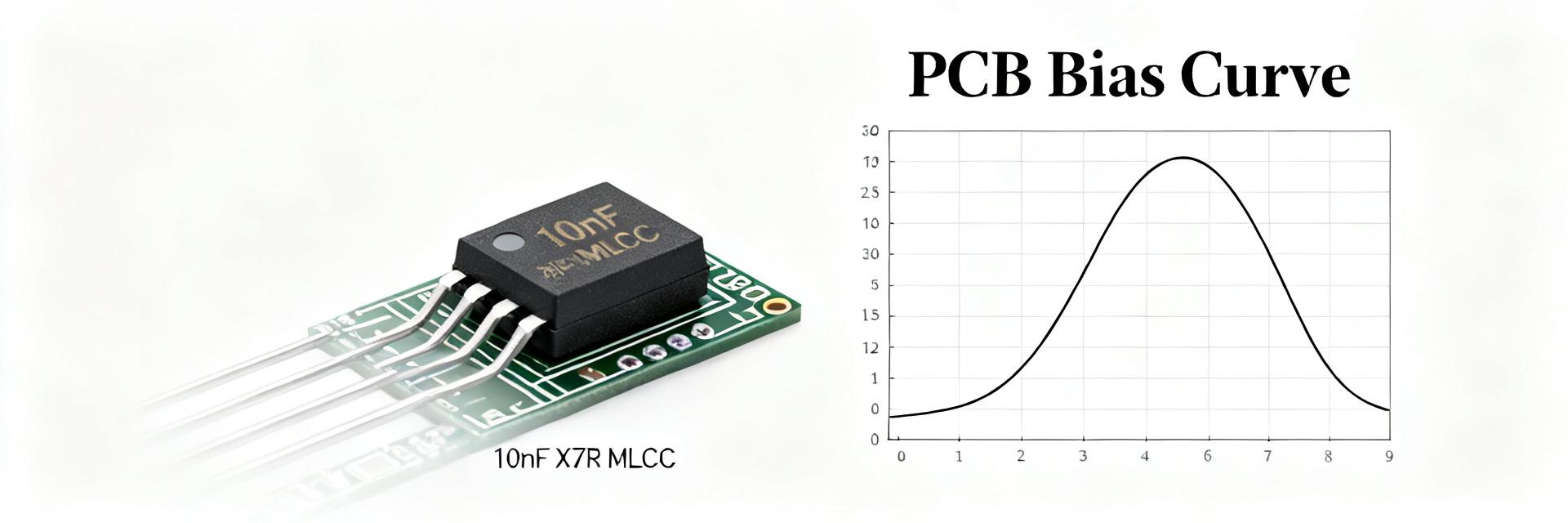
1 — Quick technical overview (background)
Point: A compact background anchors later data interpretation. Evidence: The component name encodes capacitance, voltage rating and dielectric class; mechanical form factors influence stress sensitivity. Explanation: The following subsections define electrical and mechanical specs and highlight the small set of parameters most relevant to in-circuit reliability assessments.
1.1 What “10nF 25V X7R MLCC” means (electrical & mechanical specs)
Point: Decode the label so test outputs are meaningful. Evidence: 10nF equals 0.01µF; 25V is the DC rating; X7R indicates a dielectric with roughly ±15% variation across −55°C to +125°C; common SMD sizes include 0402 and 0603 with tolerance options ±5% to ±20%. Explanation: Typical uses are high-frequency decoupling and local filtering where small bulk energy storage is acceptable but DC-bias loss must be considered.
| Spec item | Typical value |
|---|---|
| Capacitance | 10nF (0.01µF) |
| Rated voltage | 25V DC |
| Dielectric class | X7R (≈±15%) |
| Common packages | 0402, 0603 |
1.2 Key performance parameters to track
Point: Prioritize a short list of measurable parameters. Evidence: DC-bias curve, temperature coefficient, aging rate (% per decade hour), impedance/ESR vs frequency, dielectric absorption and mechanical robustness consistently predict in-service performance. Explanation: Later figures should graph DC-bias and tabulate temperature/aging; keep measurement bandwidth into the low MHz for decoupling analytics.
2 — Measured performance: DC bias, temperature & aging (data analysis)
Point: Measured trends drive design choices. Evidence: Lab DC-bias sweeps across 0–25V show substantial capacitance loss in 10nF X7R parts, especially in smaller packages. Explanation: The next items present typical voltage- and temperature-related degradations and aging behavior designers must accommodate in decoupling vs bulk applications.
2.1 Typical DC-bias and frequency response for 10nF X7R
Point: Expect measurable capacitance reduction under applied DC. Evidence: Typical 10nF 25V X7R MLCC DC bias characteristics show remaining capacitance near 70–85% at 5V, 55–75% at 10V, and 30–60% at 25V depending on geometry and vendor. Explanation: For decoupling, ensure effective capacitance at operating bias; for bulk energy storage, consider higher-voltage or C0G alternatives when bias loss is unacceptable.
2.2 Temperature dependence and aging trends
Point: Temperature and time further reduce capacitance. Evidence: X7R parts typically remain within ±15% over temperature range, but long-term aging yields logarithmic declines (e.g., 1–3% per decade hour early, slower later), and thermal cycling accelerates net loss. Explanation: Use a small temperature vs % change table and prescribe test conditions (e.g., −55°C to +125°C cycles, damp-heat 85% RH/85°C) for qualification.
| Condition | Expected %ΔC |
| Ambient → +85°C | −2% to −10% |
| 10× thermal cycles | additional −1% to −5% |
| First decade hours (aging) | −1% to −3% |
3 — Failure modes & root causes (data analysis / case)
Point: Failures cluster into electrical and mechanical classes with distinct signatures. Evidence: Field returns and lab faults typically show capacitance loss, micro-shorts from ESD, increased ESR, or open cracks after mechanical stress. Explanation: Correct diagnosis depends on correlating symptom (rail instability, noise, heating) with non-destructive inspection and electrical rework.
3.1 Electrical and material failure modes
Point: Identify electrical symptoms early. Evidence: Capacitance loss (aging, bias), micro-short/ESD damage and rising leakage or ESR manifest as increased ripple, slower transient response or intermittent resets. MLCC failure rates reported in returns are often dominated by assembly-induced shorts and bias-related capacitance deficiency. Explanation: In-circuit impedance sweeps, insulation resistance, and time-domain noise traces help separate modes.
3.2 Mechanical and process-related root causes
Point: Mechanical stress is a leading root cause for returns. Evidence: PCB flex, solder fillet issues, and improper reflow profiles produce micro-cracks visible on cross-section or X-ray; drops and board-level bending cause intermittent opens. Explanation: Correlate failures with assembly records—reflow profiles, stencil design and fixture stresses—and use X-ray/IR thermography for batch triage.
4 — Benchmarks: failure rates & reliability metrics (method guide / data)
Point: Translate test outcomes into industry metrics. Evidence: Common metrics include PPM (failures per million), FIT (failures per 10^9 device-hours) and MTBF conversions; example conversions clarify expectations. Explanation: Use standardized calculations from your test dataset to compare lots and application classes.
4.1 Interpreting failure rates: PPM, FIT, MTBF
Point: Practical worked example reduces confusion.
Evidence: Suppose 3 failures in 1,000 parts during 1,000 hours of test: total device-hours = 1,000 × 1,000 = 1,000,000 dh.
FIT = (3 failures / 1,000,000 dh) × 10^9 = 3,000 FIT.
PPM over the sample = (3 / 1,000) × 10^6 = 3,000 PPM.
Explanation: Use these conversions to scale lab results to fleet expectations and to set acceptance gates.
4.2 Typical field/test benchmarks by package & use-case
Point: Expect large spreads by application and package. Evidence: Low-stress board decoupling in consumer products often yields single-digit to low-hundreds PPM in returns; high-stress automotive or power electronics experience PPMs several times higher without targeted qualification. Explanation: Build a benchmarking table by package size, application stress level and dominant failure mode for internal tracking and supplier negotiation.
5 — Test methods & how to measure real-world performance (method guide)
Point: Define a concise test matrix for reproducible results. Evidence: Key lab tests include DC-bias capacitance sweeps, temperature cycling, thermal shock, damp-heat (85/85), mechanical bending and ESD screening. Explanation: Adopt pass/fail criteria tied to functional thresholds (e.g., >50% capacitance at operating bias for decoupling) and log lot traceability.
5.1 Essential lab tests (what to run and why)
Point: Prioritize tests that correlate to field stress. Evidence: Recommended parameters: DC-bias sweep at 0, 5, 10, 25V; temperature cycling −55°C/+125°C, 10–20 cycles; damp-heat 85°C/85% RH for 1,000 hours; mechanical bending per IPC guidance. Explanation: Use automated LCR sweeps and record impedance phase to detect early ESR shifts; include sample cross-sections for suspect lots.
5.2 Field-data collection & statistical analysis
Point: Good field data beats assumptions. Evidence: Collect returns with board ID, lot code, reflow profile and failure symptoms; use simple binomial confidence intervals for PPM estimation and chi-square for comparing lots. Explanation: Provide a standardized CSV layout (part, lot, board, symptom, time-to-fail) to enable rapid aggregation and root-cause correlation.
6 — Design & qualification best practices (actionable recommendations)
Point: Combine selection, layout and process controls to reduce returns. Evidence: Effective measures include selecting larger package when bias loss matters, requiring DC-bias curves from datasheets, lot sampling and AEC-style qualification for critical systems. Explanation: When stability is critical, prefer NP0/C0G or higher-voltage parts; otherwise, test representative lots under expected bias and thermal profile.
6.1 Component selection and qualification checklist
Point: A short checklist reduces oversight. Evidence: Verify DC-bias curves, request aging data, sample per lot, demand reflow and mechanical robustness data, and run accelerated life on representative lots. Explanation: Document acceptance gates and require manufacturer test reports for high-reliability programs.
6.2 PCB layout, assembly, and mitigation tactics
Point: Layout and process often determine in-field reliability. Evidence: Keep decouplers close to pins, control solder fillet and pad design to reduce flex, avoid placing MLCCs across large board cutouts, and use conformal coating if humidity-driven failures occur. Explanation: Flag designs with long traces, thermal hotspots or high operating voltages for expanded testing before production ramp.
Summary
- Expected behavior: 10nF 25V X7R MLCC parts show significant DC-bias loss; designers must verify in-circuit capacitance at operating voltage and account for aging and temperature drift to meet transient goals.
- Common failures: MLCC failure rates are dominated by assembly-induced mechanical cracks, ESD shorts and bias-related capacitance deficiency; test campaigns should separate electrical vs mechanical signatures.
- Measurement & benchmarks: Convert test failures into PPM/FIT using device-hour math, and build package/application-specific benchmark tables to track supplier/lot performance across production.
- Mitigation: Select larger packages or alternative dielectrics for stability-critical uses, enforce process controls, and run representative accelerated tests tied to functional pass/fail criteria.
How reliably will a 10nF 25V X7R MLCC perform in my design?
Answer: Performance depends on operating bias, temperature and assembly stress. Verify capacitance at operating voltage via DC-bias sweeps, inspect reflow and board design for flex risks, and use lot-sampling accelerated life data to estimate expected MLCC failure rates for your application.
What tests should be run to estimate MLCC failure rates?
Answer: Run DC-bias capacitance sweeps, temperature cycling, damp-heat (85/85), mechanical bending and ESD screening. Record device-hours and failures to convert to FIT/PPM; use statistical confidence intervals to size samples for reliable PPM estimates.
When should I choose alternatives to X7R for a 10nF requirement?
Answer: If in-circuit capacitance at operating bias must remain near nominal (±5%) or low loss is critical for timing/filters, choose NP0/C0G or higher-voltage X7R parts with verified bias curves. Also choose larger packages to reduce bias-related percent loss when PCB space allows.
