🚀 Key Takeaways
- ✅ Total Budget: Expect $1,000–$5,000 for full replacement including labor/machining.
- ✅ OEM Advantage: Guarantees factory tolerances and preserves vehicle warranty.
- ✅ Performance Gains: Premium rings can reduce friction by 15%, increasing usable HP.
- ✅ Critical KPIs: Monitor oil consumption (ml/1k miles) and compression psi post-install.
Replacing piston rings as part of an engine rebuild typically contributes to a parts-and-labor cost swing that can range from about $1,000 to $5,000 in the US market. Point: that range frames buyer decisions. Evidence: common shop estimates and market surveys cluster total replace jobs in that band. Explanation: this article explains why costs vary, compares OEM vs aftermarket value propositions, and gives practical buying guidance, referencing piston rings and pricing factors for clear decision-making.
💡 Value Insight:
Point: readers need actionable, data-driven insight. Evidence: repair-shop quotes, parts catalogs, and aftermarket tier breakdowns consistently show large variance between parts-only and complete service costs. Explanation: the sections below break background, cost data, manufacturing drivers, case scenarios, and a checklist so owners and fleet managers can make informed trade-offs without chasing brand names.
Market background: What piston rings are and why their cost matters
What piston rings do and common types to expect
Point: piston rings seal combustion, meter oil, and scrape excess oil from cylinder walls. Evidence: typical ring sets include a top compression ring, a second ring (aid in scraping/compression control), and an oil-control ring. Explanation: material and finish differences—hardening, coatings, precision grinding—affect sealing performance and longevity; these factors influence selection by DIYers and fleet managers and inform OEM vs aftermarket decisions.
Why cost matters: impact on engine performance, longevity, and total rebuild pricing
Point: ring quality affects long-term ownership costs. Evidence: small differences in oil control and sealing lead to measurable changes in oil consumption, emissions, and compression retention. Explanation: consider the phrase piston rings cost vs long-term engine costs—paying more for tighter tolerances and better coatings can reduce oil use, extend service intervals, and lower lifecycle expense compared with repeated cheap replacements; use pricing as one input among lifecycle metrics.
Data-driven cost breakdown: Typical price ranges
Retail & OEM baseline pricing
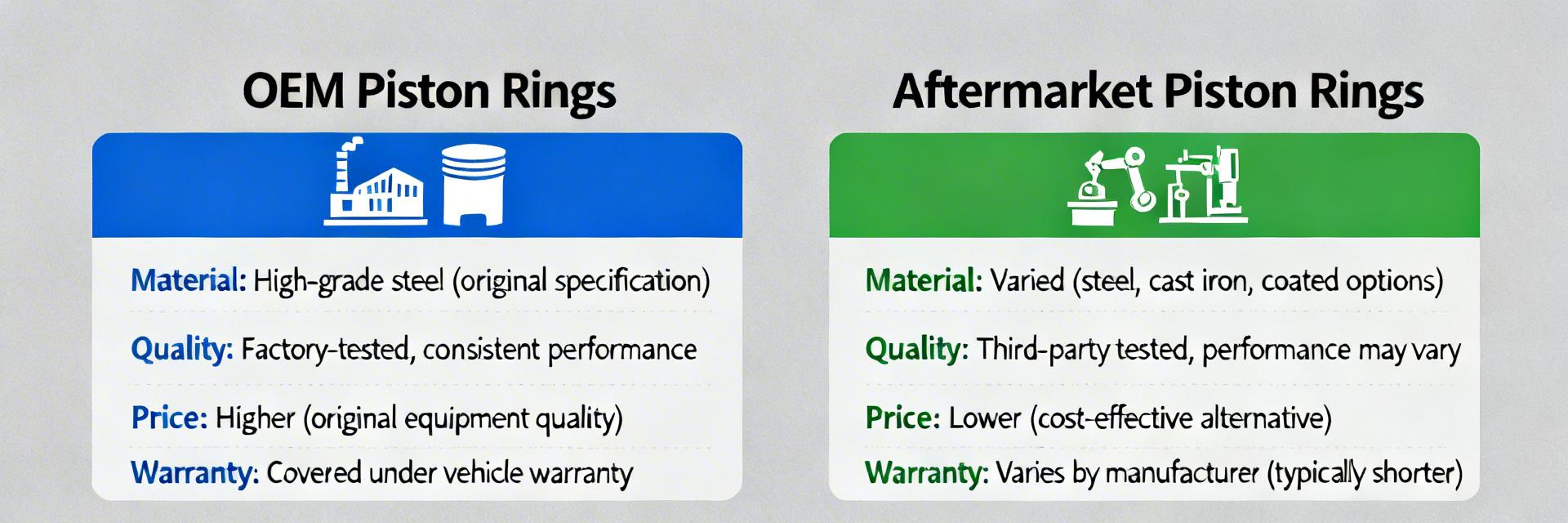
Point: OEM sets sit at a predictable premium. Evidence: MSRP bands reported by parts channels place factory-spec ring sets in low–mid–high ranges depending on engine complexity; factors raising OEM pricing include matched factory specs, tighter tolerances, warranty integration, and distribution costs. Explanation: for vehicles where specification matching and warranty continuity matter, the OEM premium buys fitment certainty and documented tolerances.
How pricing is determined: manufacturing & specs
Point: production processes and metallurgy drive cost. Evidence: steps like heat treatment, precision grinding, surface coating, and end-gap machining add both time and equipment cost. Explanation: tighter tolerances and advanced coatings require additional processing and inspection; those inputs raise component pricing but can translate into improved sealing and lower wear rates over time.
"Never save $50 on rings only to spend $2,000 on labor twice. The biggest mistake I see is DIYers skipping the cylinder honing process. Even the most expensive OEM rings won't seal properly on a glazed cylinder wall. Always verify your ring end-gap with a feeler gauge—out-of-the-box specs aren't always perfect."
Typical Application Scenarios
Hand-drawn illustration, not a precise schematic
Daily CommuterOEM Ring Set + Standard Gaskets. Focus: Reliability & Warranty.
Hand-drawn illustration, not a precise schematic
High-PerformanceNitride-Coated Rings + Precision Honing. Focus: Heat Resistance.
Summary
- Choose based on objectives: OEM sets favor specification matching and warranty support, while aftermarket options range from economy to premium and influence total lifecycle pricing; measure baseline metrics before work.
- Expect parts-only cost bands from roughly $40 to $600 and total-replace jobs commonly in the $1,000–$5,000 range once machining and labor are included; prioritize proper machining for reliability.
- Track KPIs after installation—oil consumption and compression retention—to judge whether the selected piston rings delivered the intended value and justified the upfront expense.
Frequently Asked Questions
How much do piston rings cost to replace including labor?
Typical total costs vary widely: parts-only ranges from roughly $40 (economy) to $600+ (premium or complex engines), while complete replacement including machining and labor commonly lands between $1,000 and $5,000 depending on shop rates and required machine work; get itemized quotes to compare pricing accurately.
Are aftermarket piston rings as reliable as OEM for daily drivers?
Quality aftermarket mid-range sets can match OEM durability when paired with correct machining and installation; the risk is highest with inexpensive economy kits or skipped machine work. Decision should weigh warranty/fitment needs against budget and long-term maintenance plans.
What metrics should I track to see if my ring choice was worth the cost?
Measure baseline oil consumption (ml per 1,000 miles), perform periodic compression tests across cylinders, and record service intervals. Improvements in these KPIs within the first 5,000–10,000 miles indicate a successful selection and justify higher initial pricing when lifecycle savings follow.
