
06031A8R0C4T2A Specs Analysis: Performance & Tolerances
Data-Driven Hook: The part’s published datasheet lists 8 pF ±0.25 pF, 100 V rating, C0G/NP0 dielectric, 0603 package, and an operating range of −55 °C to +125 °C. Small absolute tolerances matter in precision RF, filtering, and timing circuits.
Absolute tolerance on single-digit picofarad values directly affects resonant frequency and insertion loss in narrowband networks. This analysis interprets electrical performance, tolerance specs, and provides practical test/design guidance.
Background: Part Overview & Key Specifications
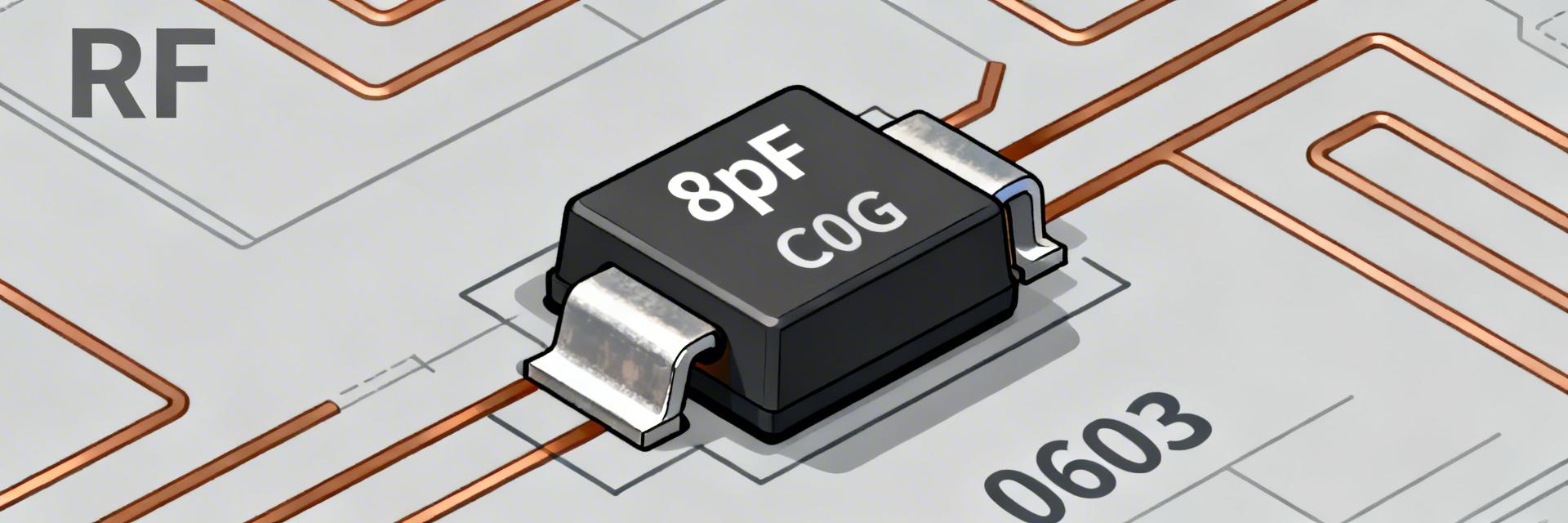
Key Spec Summary
| Nominal Capacitance | 8 pF |
| Tolerance | ±0.25 pF |
| Rated Voltage | 100 V |
| Dielectric | C0G (NP0) |
| Package | 0603 (Inch) |
| Temp Range | −55 to +125 °C |
Application Context
Typical application domains include precision RF networks, high-stability timing circuits, and compact high-voltage modules. Designers choose C0G 0603 MLCCs when low dielectric loss, negligible aging, and stable capacitance across temperature and bias are required. The tight absolute tolerance suits applications demanding predictable resonance and low phase noise.
Data Analysis: Electrical Performance vs. Conditions
Capacitance Stability
C0G/NP0 dielectrics exhibit near-zero temperature coefficient and minimal aging. DC bias effects at 8 pF are typically small but measurable. For an 8 pF 0603, expect only small percent shifts with temperature and DC bias. However, verify lot-to-lot behavior as tenths of a picofarad can matter in precision resonant circuits.
C0G Temperature Drift (~0 ±30 ppm/°C)
Frequency Response & ESR
ESR and dissipation factor (DF) typically rise with frequency. Low-loss C0G keeps DF minimal across RF bands (typically 10-4 to 10-3 range). For RF and timing, use an impedance analyzer or VNA to capture resonance and loss accurately across the intended bandwidth.
Tolerance Implications & Statistical Considerations
Interpreting ±0.25 pF on 8 pF
An absolute tolerance of ±0.25 pF is a relative error of about 3.125%, producing roughly a 1.56% shift in resonance frequency (f ∝ 1/√C).
In practice, a 1.56% frequency shift is acceptable in many broadband RF matching networks but marginal for high-Q filters. Typical production variance may cluster around nominal, but the datasheet tolerance is the guaranteed limit. For inspection, sample 30–60 units per lot for qualification.
Test & Verification Methods
Measurement Procedure
- Use 4-terminal Kelvin fixtures to minimize parasitics.
- Calibrate OPEN/SHORT before measurement.
- Measure at 1 MHz (or operating frequency).
- Apply 0.5 Vrms test signal after thermal soak.
Common Pitfalls
- Fixture parasitic capacitance (can add fF to pF).
- Excessive lead lengths skewing results.
- Heat-induced shifts during soldering.
- Inadequate instrument guard-ring usage.
Example Use-Cases & Design Calculations
LC Filter Budget
For f0 = 100 MHz and C = 8 pF, L ≈ 316 nH. A ±3.125% capacitance change yields ±1.56 MHz shift at 100 MHz. Designers must decide if this fits the filter's bandwidth.
Matching Strategies
For phase-sensitive circuits, use component matching or calibration. Strategies include parallel combinations to average tolerances or implementing firmware-based frequency correction offsets.
Actionable Selection & Design Checklist
Procurement Red Flags
• Verify if tolerance is absolute (pF) or percent (%).
• Confirm voltage ratings match system worst-case.
• Check lot traceability for high-reliability apps.
Mitigation Tactics
• Parallel two identical caps to average variance.
• Include test points for in-system verification.
• Add margin in Inductor selection for tuning.
Summary
- 8 pF nominal with ±0.25 pF yields ~3.125% variation; critical for narrowband RF stability budgets.
- C0G/NP0 dielectric and 100 V rating provide low loss and wide operating margin.
- Measurement requires calibrated 4-terminal fixtures and thermal conditioning for accuracy.
- Mitigate tolerance issues via parallel averaging, trimming, or firmware-based calibration routines.

