
Recent distributor stock snapshots and shipment data show persistent tightness for small high-voltage MLCCs. This briefing provides a practical, US-focused view of MLCC availability, pricing signals, and sourcing actions.
Market Indicators Distributor on-hand stock, lead-time surveys, and shipment volumes signal constrained short-lead coverage. Evidence from repeated out-of-stock flags and allocation advisories indicates that small, high-voltage MLCCs sit at the intersection of miniaturization demand and limited process capacity. Consequently, US buyers face elevated procurement risk today.
Market Snapshot: Why Small High-Voltage MLCCs Matter
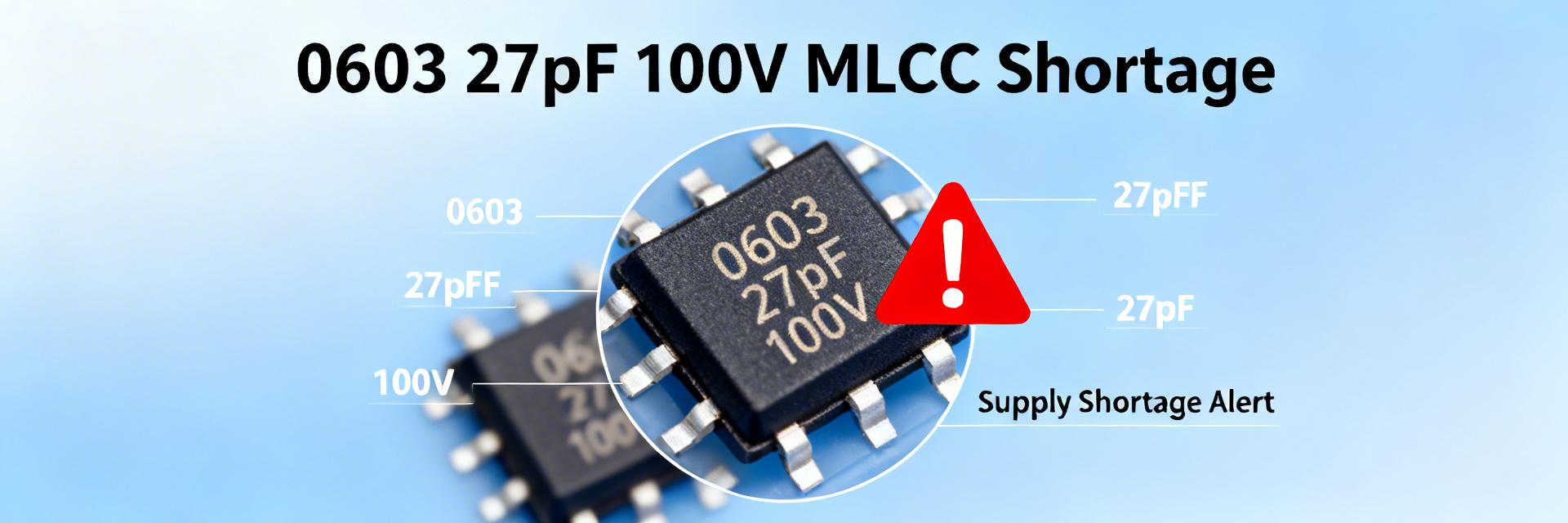
Understanding why MLCC availability matters helps prioritize actions. Sub-0603 demand growth and the proportion of high-voltage SKUs in BOMs have risen significantly in telemetry, industrial, and power-management designs. These design constraints—small form factor plus 100V rating and stable capacitance—make parts like the 0603 27pF 100V difficult to substitute without a complete redesign.
Role in Product Designs
The 0603 27pF 100V is a recurrent BOM item. Engineers commonly specify it for RF decoupling, timing, and filtering where board space is constrained and voltage margins exceed typical low-voltage capacitors. Because capacitance stability and voltage derating requirements are tight, designers find limited acceptable alternates within the same footprint.
Supply-Side Drivers
Structural supply drivers compress available inventory. Industry production concentration, complex process steps for high-voltage stacks, and shifting dielectric demand create bottlenecks in sub-0603 SKUs. These factors mean SKU growth outpaces capacity expansion; expect frequent allocation notices and lead-time divergence.
Current Supply Trends: 0603 27pF 100V
Recent data shows longer lead times and more allocation for specific small high-voltage SKUs. For US buyers, this translates to a shrinking pool of short lead-time offers and rising reliance on distributor buffer stock.
Lead Time Trend (Weeks)
Stock Levels and Allocation
Stock heatmaps reveal a concentration of shortages. Frequent out-of-stock flags appear across distributor and EMS channels. Procurement should track short lead-time availability daily and maintain escalation paths for allocation.
Regional Channel Differences
North American distributors often have higher spot premiums but immediate ship options. EMS partners show longer blanket commitments, while APAC sourcing yields scale but higher logistics risk. US buyers typically see tighter supply at local distributors.
Pricing, Lead-Time Impact, and Allocation Dynamics
Quoting behavior shows divergence between small-volume and bulk purchasers. When lead time doubles, safety stock multipliers must increase to maintain service levels. For example, doubling lead time from 8 to 16 weeks suggests doubling safety stock to buffer against demand variance.
Sourcing, Design, and Substitution Strategies
Design Tactics
- •Footprint Planning: Accept 0805 footprints where board space allows.
- •Derating Margins: Specify broader voltage ranges to increase candidate SKUs.
- •Parallel Topology: Use multiple smaller values if a single 27pF is unavailable.
Procurement Tactics
- •Multi-Sourcing: Qualify at least two secondary suppliers globally.
- •Blanket Orders: Establish time-phased buys to secure allocation.
- •Contract Clauses: Include priority allocation language in supply agreements.
Case Examples and Buyer Checklist
Success: Strategic Sourcing
Outcome: Early multi-sourcing avoided allocation and saved four weeks of lead time. By qualifying an 0805 alternate early, the production line remained active despite 0603 shortages.
Failure: Single-Source Reliance
Outcome: Single-source reliance caused significant production delays and a 15% spot-cost increase. The lack of a secondary footprint forced an emergency redesign during peak production.
Actionable Checklist for US Teams
Immediate (30 Days)
- Daily short-lead monitoring for 0603 27pF 100V.
- Place strategic safety buys (2–4 weeks demand).
- Trigger alerts for out-of-stock events.
Medium (3–12 Months)
- Add alternate footprints (0805) to BOM.
- Qualify 2 secondary global suppliers.
- Negotiate blanket orders with allocation clauses.
Escalation Path
- Standardize emergency buy templates.
- Define approval matrix for expedited spend.
- Monthly cross-functional availability reviews.
Summary
Monitor: MLCC availability is constrained for small high-voltage SKUs; maintain daily monitoring to detect allocation early.
Secure: Prioritize safety buys and blanket orders for at-risk BOM items to limit disruption and control spot premiums.
Redesign: Implement footprint flexibility (e.g., 0805) and substitution rules to reduce single-SKU dependence.

