
The 06031A101J4T2A is a 100 pF, ±5% C0G (NP0) MLCC in a 0603 footprint specified for 100 V DC. This datasheet-style quick reference targets precision and high-voltage applications such as timing networks, RF bypass, and precision filters. This brief consolidates the essential electrical, mechanical, and test guidance engineers need to evaluate 06031A101J4T2A before prototyping or production.
Quick Specs & At-a-Glance Overview
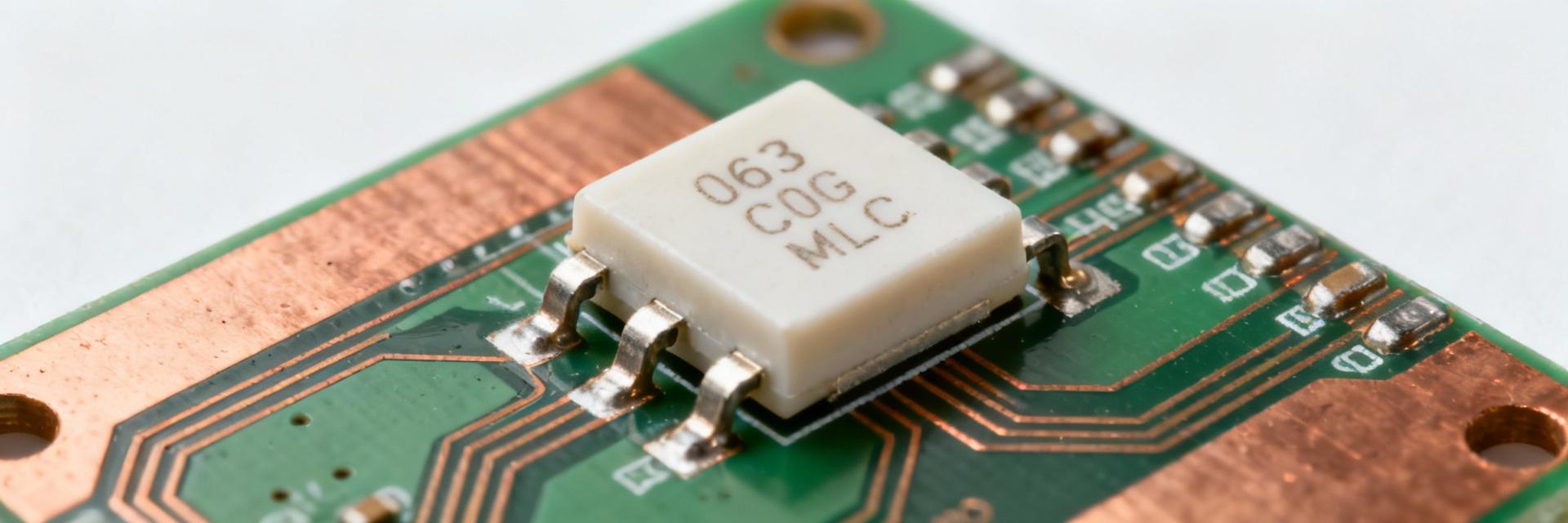
Key Electrical Specifications
Precision systems demand low-drift capacitors with stable behavior across temperature and bias. Manufacturer datasheet entries for C0G MLCCs show near-zero ppm/°C drift and low dissipation factor. Expect low DF, very low temperature coefficient, and insulation resistance specified by the manufacturer; pull exact leakage and DF from the manufacturer datasheet before final design.
Electrical Summary
| Parameter | Typical Value | Units | Note |
|---|---|---|---|
| Capacitance | 100 | pF | At 1 kHz, 25°C |
| Tolerance | ±5 | % | Code J |
| Dielectric | C0G (NP0) | - | Near-zero tempco |
| Voltage Rating | 100 | V DC | Rated DC |
| Package | 0603 (1608) | - | SMD |
Electrical Characteristics & Performance
Temperature Stability
C0G/NP0 offers near-zero temperature coefficient, critical for timing and precision filters. Datasheets show drift typically within ±30 ppm/°C. Across −55°C to +125°C, capacitance change is negligible compared with X7R or Y5V.
Voltage & Frequency Response
C0G capacitors exhibit minimal DC bias capacitance loss and low ESR. At RF and timing frequencies, a 100 pF C0G maintains expected impedance and cutoff behavior; include manufacturer impedance vs. frequency plots in validation.
Dimensions & PCB Mounting
Mechanical Dimensions
The 0603 (1608 metric) footprint is compact. Nominal length 1.6 mm, width 0.8 mm. Verify pad land pattern per recommended solder fillet and maintain minimal board flex to avoid micro-cracking during reflow.
Assembly Considerations
Parts ship on reels/tape for SMT. Follow IPC/JEDEC-compatible reflow profiles, minimize mechanical shock, and consider stress-relief layout for high-voltage assemblies.
Part Number Decoding & Cross-Reference
Part Number Decoding: Standard MLCC PN schemes encode package, capacitance (101=100 pF), tolerance (J=±5%), voltage, and packaging suffix. Validate each code element against the manufacturer datasheet—for example, a different suffix may change tape orientation or packing quantity.
Equivalent Selection: When substituting, match capacitance, voltage, dielectric (C0G), footprint, and height. Check DC bias C-V curves and qualification data such as temperature range or automotive grading.
Typical Applications & Circuits
A 100 pF C0G in 0603 is versatile for precision analog and RF tasks. Common uses include timing networks, RF tuning/bypass, and precision filter components. In a high-frequency RC filter, expect negligible capacitance change with temperature, preserving filter center frequency and stability.
Procurement & Testing Checklist
- ● Confirm capacitance, tolerance, and voltage rating.
- ● Review C-V and impedance curves in the datasheet.
- ● Test C-V at intended DC bias and perform ESR sweeps.
- ● Verify date codes and traceability for high-reliability lots.
- ● Plan reel quantities to minimize manual handling.
- ● Perform post-reflow visual inspection for solder joints.
Summary
The 06031A101J4T2A is a compact 100 pF, ±5% C0G (NP0) capacitor rated for 100 V—well suited where low drift and high-voltage capability are required.
- Core Spec: 100 pF, ±5%, C0G, 100 V, 0603 footprint.
- Stability: Near-zero ppm/°C and minimal DC bias effects for precision systems.
- Validation: Essential to run C-V bias and impedance sweeps before volume production.

