Data-driven engineering teams use official datasheets and product listings to verify consistent design cues across board-to-board and board-to-wire connectors. The most decisive datapoints to confirm are current rating, voltage rating, pitch, contact finish, and temperature range. This brief shows which specs matter, where to verify them in the datasheet, and how to turn that information into actionable procurement and test checks. Use the official datasheet PDF as the single authoritative source for final values and revision history.
Engineers should treat distributor pages and secondary listings as cross-checks only; the manufacturer datasheet contains the test conditions and exact table entries needed to validate electrical capacity, mechanical fit, and environmental conformance. This introduction frames the verification steps that follow so teams can rapidly convert spec tables into pass/fail acceptance criteria for prototypes and production buys.
01 Product Overview: Identification & Identification
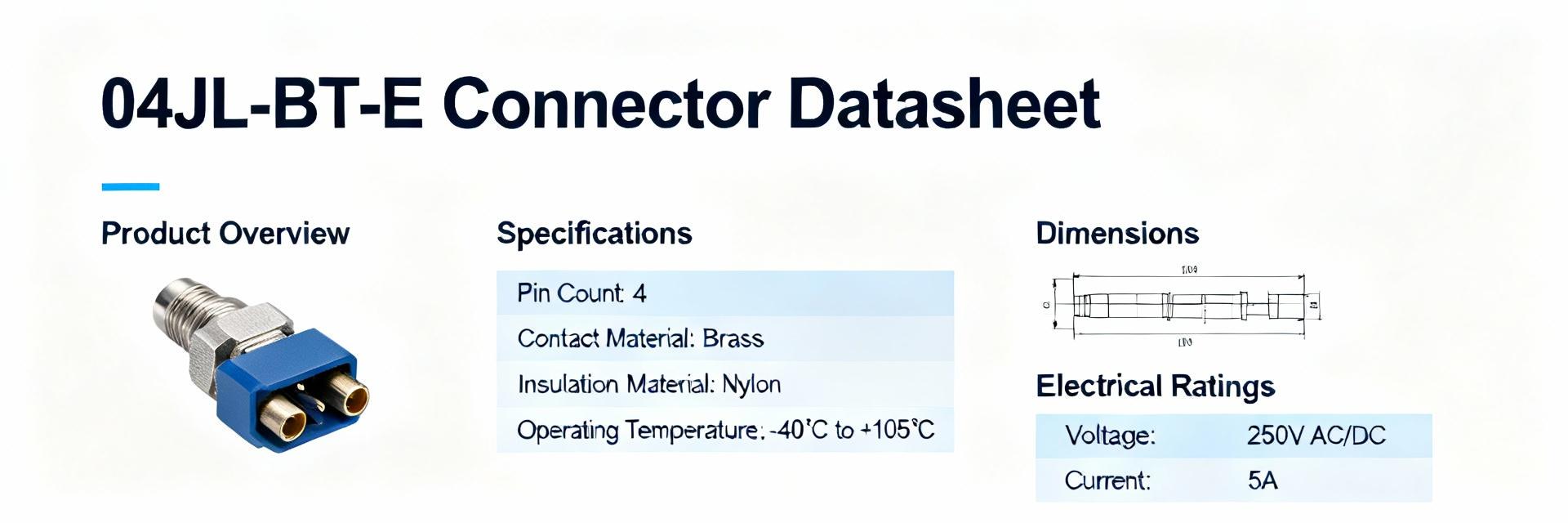
What is the JL-BT-E connector?
Point: The JL-BT-E connector is a compact multi-position receptacle commonly used for low-profile board interconnects.
Evidence: Typical variants are supplied as 4-position receptacles with a nominal 2.5 mm pitch and intended for board-mount applications in board-to-wire or board-to-board contexts.
Explanation: Designers should confirm the exact part string and variant suffixes from the official datasheet to validate mating type, housing orientation, and mounting style before footprint creation.
Key Identifiers & Naming
Point: Suffixes in the part code convey plating, finish, and lead-free status.
Evidence: Common suffix tokens include indicators for lead-free processing and contact finish options; the datasheet section on ordering information decodes these suffixes.
Explanation: Create a simple mapping table in the BOM to translate suffix → meaning and always cross-check the ordering code against the datasheet to avoid mismatched finish or material choices at procurement.
02 Electrical & Environmental Specifications
Electrical Ratings Visualization
Electrical extraction
Point: Extract the electrical table entries exactly as published. Evidence: The datasheet lists current rating (A), voltage rating (V), contact resistance (mΩ), insulation resistance (Ω), dielectric withstanding voltage (VAC), and recommended wire AWG. Explanation: Populate a comparison table when the datasheet presents multiple ratings, and annotate each value with the test condition noted in the documentation.
Environmental limits
Point: Environmental limits determine field reliability. Evidence: Report operating temperature range, humidity/salt-spray resistance, and flammability rating verbatim. Explanation: When secondary listings show different values, prioritize the official datasheet revision and its stated test standards.
03 Mechanical & Dimensional Specifications
Mechanical Note: Mechanical drawings are the single source of truth for PCB layout. Extract the mating height and detailed footprint dimensions directly from the datasheet's mechanical section. Use the drawing's tolerance notes as acceptance limits for fabrication and assembly processes.
Datasheet Checklist
- ✓ Confirm electrical ratings (Voltage/Current)
- ✓ Confirm mechanical fit (Footprint & Height)
- ✓ Check material/plating compatibility
- ✓ Verify environmental ratings and RoHS
- ✓ Review compliance and packaging details
Application Scenarios
Low-Current Signal Harness: Prioritize contact resistance and compact footprint.
Power Module Interface: Prioritize current rating and plating for corrosion resistance.
* Always map datasheet fields to these priorities to justify variant choice.
Applications, Testing, & Procurement
Typical Applications
Commonly used in compact consumer electronics, embedded modules, and industrial control assemblies where small pitch and low profile are critical. Verify mating counterpart part numbers via the datasheet cross-reference table to ensure compatibility.
Pre-production Tests
Run targeted tests: continuity under load, IR drop, insulation resistance, thermal cycling, and mechanical mate/unmate cycles. Record test pass/fail criteria tied to the datasheet values before approving production runs.
