Introduction — Recent board-level protection audits and lab reliability reviews repeatedly show that incorrect fuse selection or misread datasheet parameters is a leading root cause of field returns and safety incidents. This guide uses the 0476001.MRSN as a reference part to show exactly what to extract from the datasheet and how to verify compliance, so design engineers can cut risk and speed approvals.
Product overview & key specifications (Background)
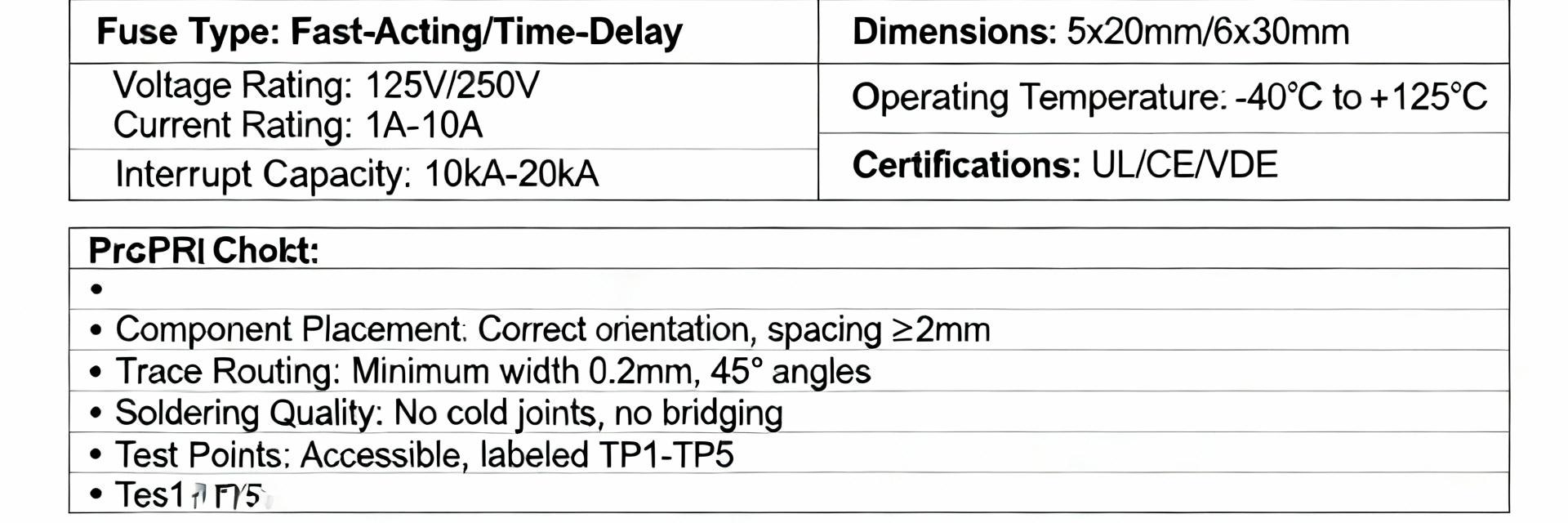
Electrical ratings to confirm
Point: Start by extracting nominal current, rated voltage (AC/DC), interrupt rating (A), time‑current characteristic (fast/slow blow), and DC cold resistance.
Evidence: the official datasheet contains a consolidated electrical table and time‑current curves.
Explanation: copy those exact fields into your spec sheet so that tolerance stack, expected inrush, and short‑circuit clearing calculations reference the same source of truth.
Physical, packaging and ordering data
Point: Pull exact dimensions, recommended PCB footprint, mounting style, and packaging details.
Evidence: datasheet mechanical drawings and ordering tables list package variants, tape & reel options, and marking codes.
Explanation: paste the footprint coordinates and recommended land pattern verbatim into the PCB data set, flag part‑number variants and lifecycle notes in the BOM for procurement verification.
Performance data & reliability analysis (Data & testing)
Interruption and time-current performance
Point: Read time‑current curves and I²t tables to size the fuse vs. expected currents.
Evidence: use the datasheet curve to derive clearance time at a given fault.
Explanation: example — if expected peak inrush is 10 A for 10 ms and a prospective fault is 200 A, compare I²t(inrush) to fuse I²t rating; select a fuse whose I²t rating exceeds inrush energy but clears at a safely low fault energy.
Environmental and thermal behavior
Point: Confirm temperature derating, solder reflow limits, humidity and vibration ratings.
Evidence: environmental tables and reflow profiles specify allowable peak solder temperature.
Explanation: plan board‑level thermal verification: measure temperature rise at nominal current, run accelerated humidity and vibration tests, and compare observed drift to datasheet claims.
How to read the datasheet: a step-by-step guide (Method)
Priority checklist for fast verification
Point: Use an 8‑item quick check before prototyping.
Evidence: derive items from the datasheet sections — electrical table, mechanical drawing, environmental limits, and ordering info.
Explanation: checklist: rated voltage/current, interrupt rating & curve, footprint, material/flammability, packaging, available test reports, traceability/lot codes, and end‑of‑life notice.
Common pitfalls and interpretation tips
Point: Watch ambiguous terms and test‑condition footnotes.
Evidence: datasheets often list interrupt rating under specific test conditions (voltage waveform, fuse holder).
Explanation: clarify AC vs. DC ratings, confirm whether interrupt rating equals breaking capacity at DC, and request supplier test data when units, waveform, or ambient assumptions are unclear.
PCB integration & application examples (Case)
Layout and assembly best practices
Point: Tie layout choices to mechanical and thermal specs. Evidence: datasheet footprint and reflow profile guide pad size. Explanation: follow recommended land pattern, add thermal relief, leave solder mask openings, and use reflow profile limits; document deviation risks.
Typical application scenarios and failure modes
Point: Identify common uses and likely failure modes. Evidence: suitability for input/port protection and battery circuits. Explanation: test for nuisance open during inrush, thermal runaway under overload, and clean interruption under short‑circuit; log all test setups.
Compliance checklist & verification steps (Actionable)
Regulatory & safety verifications to confirm
Point: Confirm RoHS/REACH declarations and applicable safety approvals. Evidence: material declarations and test reports. Explanation: keep a compliance pack containing datasheet excerpts and lot traceability.
| Specification (copy verbatim) | Value (from datasheet) | Notes |
|---|---|---|
| Rated current | [Data Required] | Confirm tolerance and test condition |
| Rated voltage (AC/DC) | [Data Required] | AC vs. DC limitations |
| Interrupt rating | [Data Required] | Specify test waveform and voltage |
| Time‑current curve reference | Figure X | Attach curve image in spec pack |
Key summary
- ✔ Extract and copy the datasheet's electrical table and time‑current curve into your design spec to ensure the 0476001.MRSN ratings drive selection and margins.
- ✔ Validate mechanical footprint, reflow limits, and packaging details directly from the mechanical drawings to avoid assembly issues and BOM mismatches.
- ✔ Run targeted bench tests—interrupt at rated conditions, inrush verification, thermal cycling and humidity—to confirm reliability claims before release.
