Compact slow-blow SMD fuses are critical as board-level power density and inrush currents rise.
Datasheet summarizes the part family in a front-table and characteristic curves.
0468.500NRHF is a 1206 Slo-Blo device used to tolerate surge currents while protecting against faults.
This technical note extracts electrical specifications, time‑current behavior, PCB footprint guidance, and procurement tips for the 0468.500NRHF so designers can rapidly assess system compatibility.
Quick Spec Snapshot (Background)
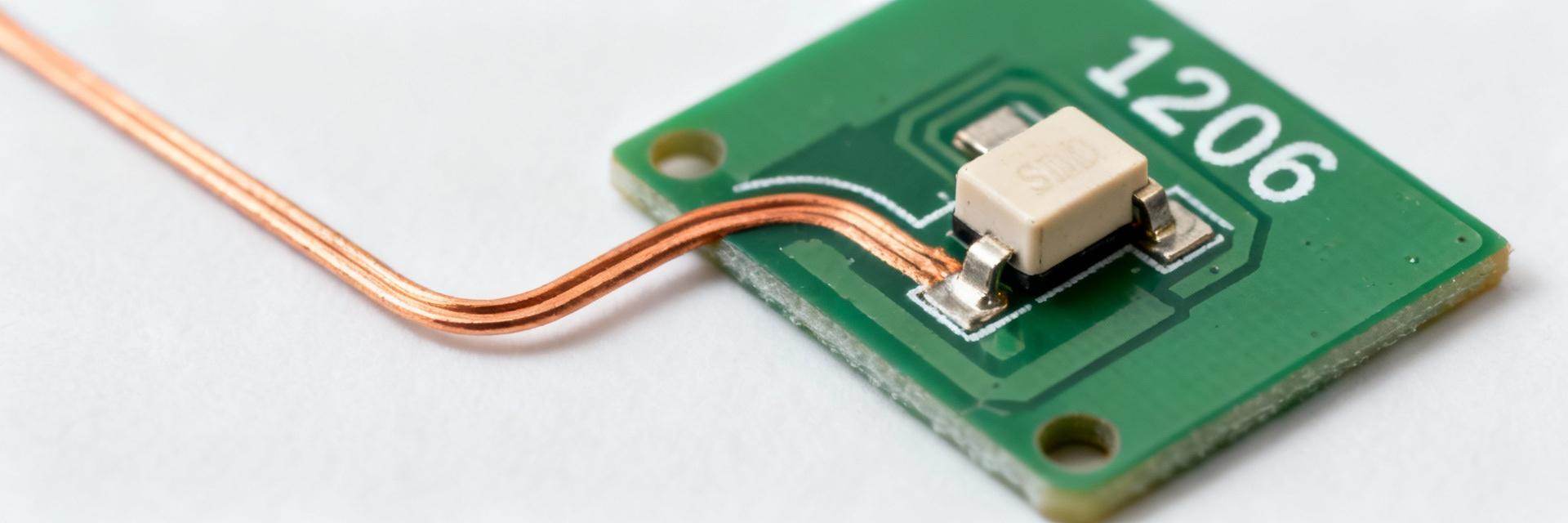
Key Electrical Specs
- Rated Current 0.5 A
- Rated Voltage 63 V
- DC Resistance (Typ) ~270 mΩ
- Interrupting Rating ≈50 A
Core electrical parameters define applicability as per Datasheet Table 1.
Mechanical & Environmental
Includes epoxy encapsulation and RoHS compliant solderable terminations.
Time-Current Characteristics & Fusing Behavior
Interpreting the Time-Current Curve
The time‑current curve shows how long the fuse sustains overloads. Engineers should read thresholds as multiples of 0.5 A:
*Large faults clear rapidly per Figure 3 of the datasheet.
I²t, Fusing Energy and Derating
Clearing energy (I²t) and pre‑arc energy inform stress on surrounding parts. Use those I²t figures to verify upstream protection and confirm sensitive capacitors or ICs survive the fault clearing event.
Typical Circuit Roles
This part suits board-level, inrush-tolerant protection roles. Typical applications include:
- ✔ Low-current power-rail protection
- ✔ Modules with startup inrush (capacitors/small motors)
- ✔ Battery-path protection in portable designs
Constraints & Limits
Avoid using the 0468.500NRHF in the following scenarios:
- ✖ Fast clearing requirements (
- ✖ Steady-state load exceeding 0.5 A
- ✖ System voltage exceeding 63 V
PCB Footprint & Soldering Guidance
Land Pattern Design
Derive pad geometry from the mechanical drawing. Allow sufficient pad annulus to avoid tombstoning. Use solder mask openings and paste stencil coverage consistent with typical 1206 SMD best practices.
Reflow Profile
Follow the datasheet reflow profile (lead-free peak). Observe IPC storage/handling and ESD precautions. Execute sample reflow runs to verify wetting and electrical continuity.
Testing, Reliability & Compliance
| Category | Evaluation Criteria | Engineer's Action |
|---|---|---|
| Environmental | Thermal cycling, humidity, and mechanical shock. | Run in-house qualification if full lot data is missing. |
| Regulatory | RoHS/REACH declarations and Interrupting rating. | Check for specific agency recognitions (UL/CSA). |
| Safety | Medical/Automotive/Industrial standards. | Perform additional verification for mission-critical apps. |
Equivalent Part Selection
Prioritize time-current curve equivalence over package alone. Check:
- • Match DC resistance and Interrupting rating.
- • Confirm mechanical drawings and tape orientation.
- • Verify temperature rating compatibility.
Procurement & BOM
Reduce supply risk by ordering sample reels for qualification. Require lot traceability and maintain recommended storage conditions for long-term reliability.
Executive Summary
The 0468.500NRHF 1206 Slo-Blo 0.5A 63V device provides compact, inrush-tolerant board protection. Design success depends on matching time-current curves, interrupting ratings, and thermal constraints.
Verify Table 1 and Figure 3 before BOM inclusion.
Perform sample reflow to confirm assembly reliability.
Use I²t values for upstream coordination.
