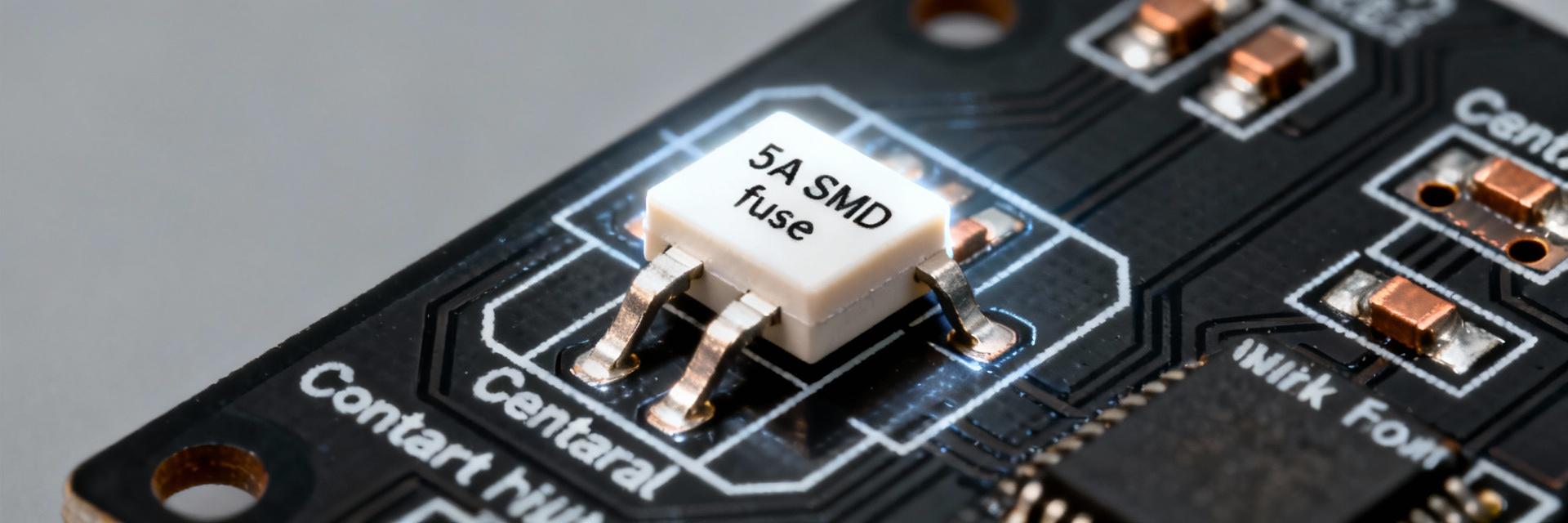
The 0459005.UR is a compact, very-fast-acting SMD fuse rated at 5 A and 125 V, optimized for low-voltage power rail protection. This guide provides actionable layout, thermal, and sourcing data for modern electronics manufacturing.
Product Overview & Identifiers
The part code identifies a PICO® family very-fast SMD fuse. Marking schemes typically encode current rating and series shorthand on strip reels and cut tape. When matching order codes, engineers must verify tape orientation and reel quantity to ensure BOM alignment.
Electrical Specifications & Performance Data
Footprint & PCB Land Pattern
Translate the PICO form factor into robust pad geometry. Recommended dimensions usually involve slightly elongated pads with 3.0–3.5 mm pad-to-pad spacing. Ensure 60–80% paste coverage with reduced center cutouts to prevent tombstoning during reflow.
- Stencil: 0.1–0.12 mm thickness recommended.
- Keepout: Avoid tall components in the immediate 2mm radius.
- Thermal Relief: Essential when connecting to heavy ground planes.
Thermal & Reliability
Fuse allowable current drops significantly with ambient temperature. Apply a conservative derating (e.g., 80% of rated current) for high-temperature environments. Repeated inrush events can fatigue the element over time.
- Monitor I²t margins for high-inrush loads.
- Verify copper heat sinking effects on trip time.
- Plan for vibration screening in industrial use cases.
Sourcing & Cross-Reference Strategy
Before finalizing your BOM, verify reel packaging and MOQ. Direct equivalents must match the form factor, speed class, I²t, and breaking capacity. Avoid swapping to a "Slow-Blow" variant without revalidating protection margins, as this may leave downstream components vulnerable during short-circuit events.
Installation & Replacement Best Practices
Reflow Profile: Follow specified peak temperatures to avoid internal element degradation. Avoid excessive reflow cycles.
Troubleshooting: Confirm fuse state with continuity checks. For replacements, use localized hot-air removal to prevent damage to adjacent sensitive components. Always root-cause the upstream event before installing a new fuse.
Summary Checklist
- The 0459005.UR is a 5 A, 125 V, very-fast SMD fuse; verify I²t behavior for power rail protection.
- Correct footprint and pad geometry are critical for solder reliability; use reduced-coverage stencil apertures.
- Thermal derating and copper plane interaction set allowable continuous current; plan for 80% derating in dense layouts.
