Comprehensive analysis of fusing behavior and thermal derating for 10 A SMD fuses in modern power designs, featuring detailed selection logic and PCB layout optimization.
Context: Measured fusing behavior and thermal derating determine whether a 10 A SMD fuse will survive surge events in modern power designs. This article utilizes the 0453010.MR datasheet to provide a clear breakdown of electrical specifications, detailed test data interpretation, and actionable selection and PCB guidance. Target readers include design engineers, test engineers, and procurement specialists evaluating board-level overcurrent protection for AC and DC power stages.
Core Logic: By translating official part datasets (time-current curves, I²t tables, and thermal derating plots) into selection rules and layout best practices, we ensure reliable 10 A operation under realistic inrush and fault conditions.
Product Overview & Key Electrical Specifications
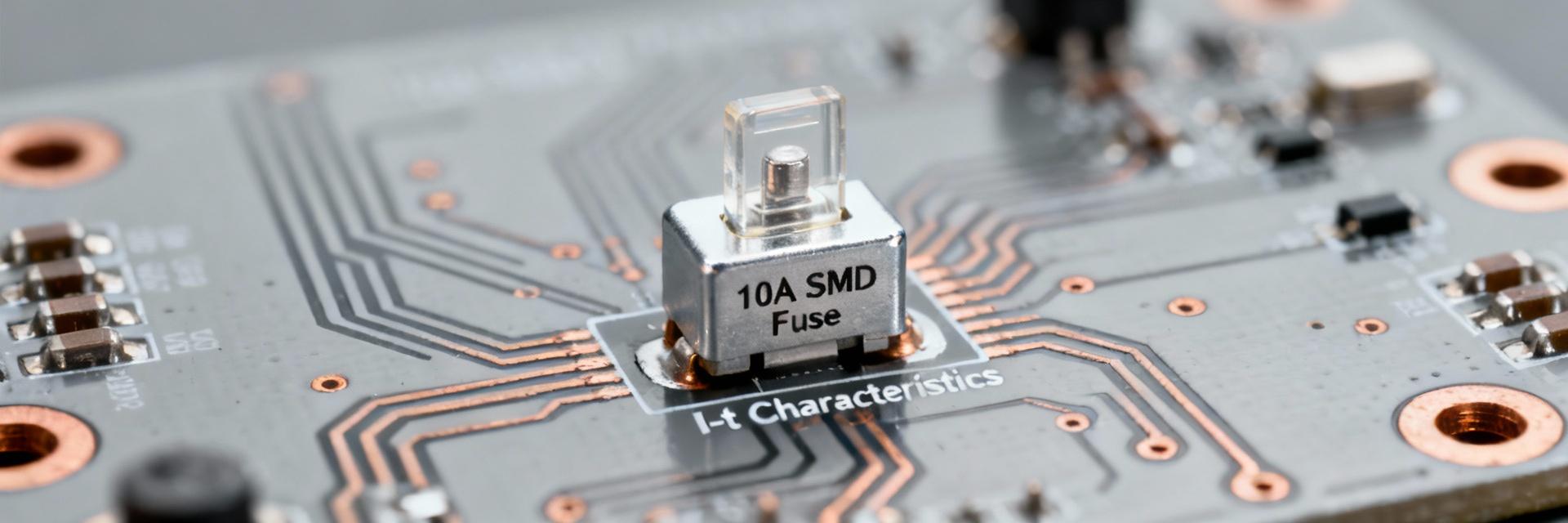
The 0453010.MR is a critical component for board-level protection. Understanding its headline numbers—including rated current, voltage ratings, and interrupting capability—is the first step in matching the fuse to system thermal and electrical constraints.
Quick Specification Summary
| Parameter | Typical Value / Notes |
|---|---|
| Rated Current | 10 A |
| Voltage Rating | 125 VAC / 125 VDC |
| Interrupting Rating | 35 A @ rated voltage (typical) |
| Nominal Cold Resistance | ≈10–20 mΩ (order‑of‑magnitude) |
| Package Dimensions | Board‑level SMD Nano package, low profile |
| Response Type | Very fast / Fast acting (low I²t) |
| Typical Power Dissipation |
~1–2 W at 10 A
|
Detailed Electrical Performance & Derating
Thermal Derating and Ambient Performance
Electrical performance depends strongly on temperature and mounting. If the derating curve indicates 90% at 40 °C, the allowable steady current becomes 0.9 × 10 A = 9 A. Always apply this adjustment for worst-case ambient plus PCB thermal rise to ensure the fuse does not run hot long-term, reducing lifecycle risk.
Key Insight: Resistance & Interrupting Limits
Nominal cold resistance values enable precise I²R loss estimates. Verify that the interrupting rating and voltage class match your highest prospective DC fault energy; mismatches can lead to arcing or failure to clear a short circuit safely.
Test Data Breakdown: Measurement & Interpretation
Standard test outputs include time-current curves, I²t fusing energy, and pulse/surge withstand. These datasets allow you to simulate whether the fuse opens before downstream parts fail or whether it survives repetitive surges without nuisance opening.
Standard Electrical Tests
- Time-current curves (Log-Log)
- I²t fusing energy tables
- Steady-state thermal rise graphs
- Solderability and reflow results
Pass/Fail Criteria
- Controlled ambient (25°C baseline)
- Low-impedance current sources
- Measurement resolution limits
- Application-specific safety margins
Application Guidance & Real-World Use Cases
The 0453010.MR is ideal for board-level protection in 125V rails, power converters, battery protection, and high-inrush USB PD stages. Reliability is maximized when peak inrush, I²t margin, and thermal environment are correctly validated.
Selection Checklist
- ✓ Peak Inrush vs. Fault Current Analysis
- ✓ I²t Reserve Computation for Downstream Protection
- ✓ PCB Cooling and Land Pattern Verification
- ✓ Voltage Class and Interrupting Rating Match
Implementation Checklist: Layout & Compliance
PCB Layout Best Practices
Orient the device to maximize copper conduction. Use thermal relief cautiously to avoid excessive heating while ensuring proper heat sinking. Place the fuse away from active hot components to maintain its derated current capacity.
Procurement & Equivalents
BOM entries must include the full part number and packaging code. When evaluating equivalents, meticulously match time-current curves and agency ratings (UL, CSA, TUV) to ensure regulatory compliance.
Summary
- Match rated current, voltage rating, and interrupting capability from the 0453010.MR datasheet to system worst-case scenarios.
- Verify time-current curves and I²t test data under representative fixture conditions to avoid nuisance opens.
- Follow precise PCB land patterns and include mitigation (snubbers, soft-start) for repetitive inrush events.
