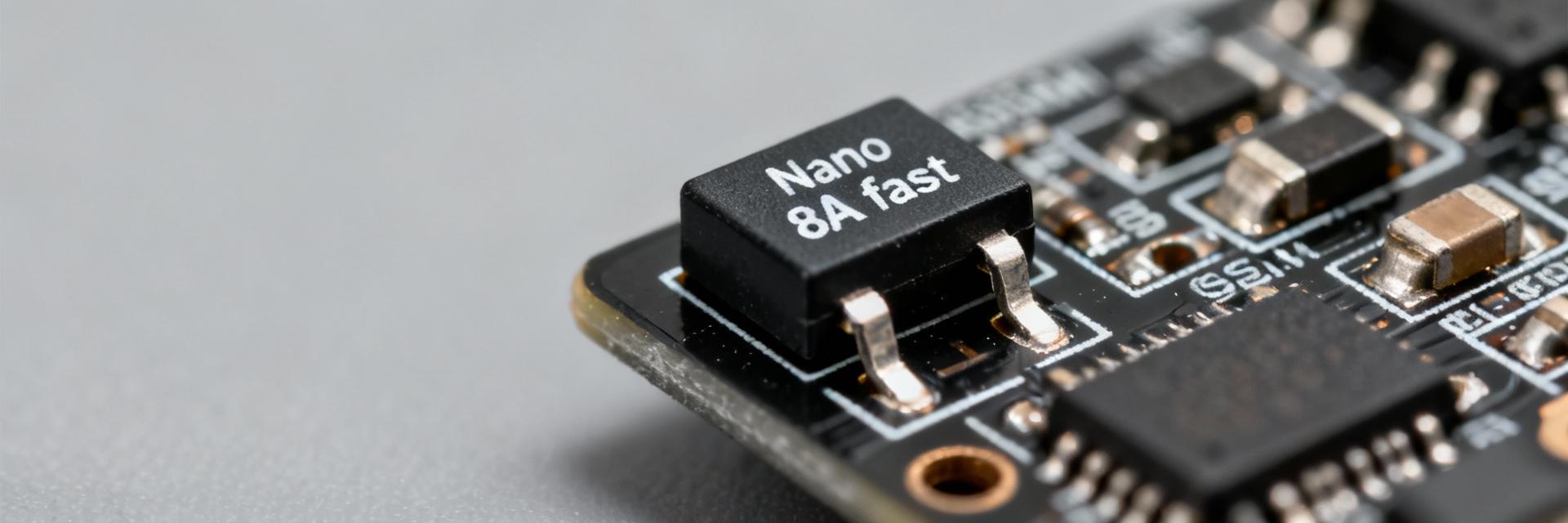
Professional-grade Nano-sized SMD fuse for compact board-level protection and high-reliability circuit designs.
The 0453008.MR is a Nano-sized Surface Mount Device (SMD) fuse engineered for compact board-level protection. Featuring an 8 A rated current and a 125 V rated voltage, it offers interrupt capabilities ranging from tens to hundreds of amps within a miniature 6.1 × 2.69 mm package. These datasheet parameters are critical for determining selection margins, PCB land-pattern optimization, and thermal management in high-density electronic designs.
Quick Background & Technical Overview
Key Specifications at a Glance
It is essential to understand the core metrics before integration. The 0453008.MR exhibits high interrupt ratings (e.g., 50 A @125 VAC / 400 A @32 VDC) and low typical DC resistance. These values dictate the continuous current thresholds, fault energy clearing capacity, and mandatory board safety spacing.
Typical Applications & Design Fit
Designed for compact secondary protection, this fuse is frequently found in secondary DC rails, adapter outputs, and USB module protection where PCB real estate is at a premium. The SMD form factor facilitates automated pick-and-place assembly but necessitates rigorous thermal and footprint validation.
Electrical Specifications Deep-Dive
Current, Voltage & Interrupt Ratings
Rated vs. continuous current and interrupt capabilities are the primary drivers for component selection. Industry practice suggests selecting a continuous rating with a margin of 125–150% of the expected load. The interrupt rating indicates the maximum fault current the fuse can safely extinguish without physical rupture.
Time-Current Behavior & Derating
The "very-fast" blow characteristic ensures rapid clearing of short-circuit events but requires attention during high-inrush startups. Ambient temperature and PCB copper density significantly impact thermal dissipation; engineers must apply derating factors based on the datasheet's thermal curves to prevent nuisance tripping.
Thermal, Mechanical & Reliability Considerations
Thermal limits and soldering specifications are vital for successful assembly. The operating temperature range spans from −55 °C to +125 °C. During production, peak reflow temperatures must be strictly controlled to protect the internal fuse element's integrity.
Qualification tests such as endurance cycling, thermal shock, and mechanical vibration assessments help mitigate field risks. These tests ensure the reliability of trip characteristics and solder joint robustness, directly impacting the system's Mean Time Between Failures (MTBF).
PCB Footprint & Land-Pattern Guide
| Parameter | Recommended (mm) | Engineering Notes |
|---|---|---|
| Body Dimensions | 6.10 × 2.69 | Reference package outline for clearance |
| Pad Length | 2.2 – 2.8 | Balances solder volume and fillet formation |
| Pad Width | 0.9 – 1.3 | Ensures mechanical stability |
| Pad Gap | 3.0 – 3.5 | Crucial to prevent solder bridging |
Selection & Implementation Strategy
Selection Guide
Match electrical and thermal constraints. For rails with repeated inrush, consider up-rating the current or selecting a slower blow characteristic. Always verify that the interrupt rating exceeds the worst-case prospective fault current.
Procurement Strategy
Maintain a list of qualified alternates matching footprint, time-current curves, and thermal behavior. Perform functional trip tests and assembly trials before substituting components in the Bill of Materials (BOM).
Implementation Checklist & Case Study
Step-by-Step Integration: 5V/3A Rail Case
- Selection: Choose 8 A fuse (0453008.MR) to provide >150% margin for a 3 A continuous load.
- Validation: Verify that the "very-fast" curve accommodates 2x inrush transients without degradation.
- Thermal: Add local copper pours for heat sinking and use the recommended pad geometry.
- Verification: Implement test points for pre- and post-fuse voltage monitoring during prototype testing.
Summary
Effective implementation of the 0453008.MR requires a holistic approach using datasheet figures—rated current, voltage, interrupt rating, and thermal limits—to drive selection and layout. Key takeaways include:
- Margin continuous loads by 125–150%.
- Precision in pad geometry prevents assembly defects like tombstoning.
- Rigorous thermal and mechanical qualification reduces field failure risks.
