The 0452003.NRL is a high-performance 3 A time-delay surface-mount protection device, engineered for robust circuit reliability against inrush events.
The 0452003.NRL is specified as a 3 A time-delay surface-mount protection device with a nominal melting I2t ≈ 20.16 A²s, rated voltage 125 V (AC/DC), and a typical cold resistance near 0.034 Ω. I2t represents the energy integral (A²·s) required to melt the element and directly determines whether short-duration inrush events will clear the fuse or pass them safely. For board-level reliability, comparing measured pulse I2t against the nominal melting I2t predicts false trips and supports proper mitigation choices. This note aims to give an engineer-ready summary of electrical and thermal specs, how to interpret and measure I2t in real designs, common I2t-driven failure modes, reliable test methods, and a practical selection/checklist to avoid nuisance opens.
Product Background & Core Specifications
Physical & Electrical Baseline
Point: Designers need immediate numeric references for layout and thermal analysis. Evidence: Key datasheet values include package size (nano2 / 2410 footprint), rated current 3 A, rated voltage 125 V, typical cold resistance ≈ 0.034 Ω, and operating range −55°C to +125°C. Explanation: Use the part footprint for pad design and account for reel packaging for pick-and-place; verify exact mm dimensions from the manufacturer datasheet when creating the PCB land pattern.
Time-delay Type & Slo-Blo Implications
Point: The slo‑blo designation signals tolerance to short inrush pulses. Evidence: Slow‑blow construction accepts brief high-current events (motor startups, capacitor charging) without opening. Explanation: Choose slo‑blo if expected transient energy (I2t) is significant but short; avoid in fast-fault circuits where quick interruption is critical.
Nominal Melting Energy (I2t)
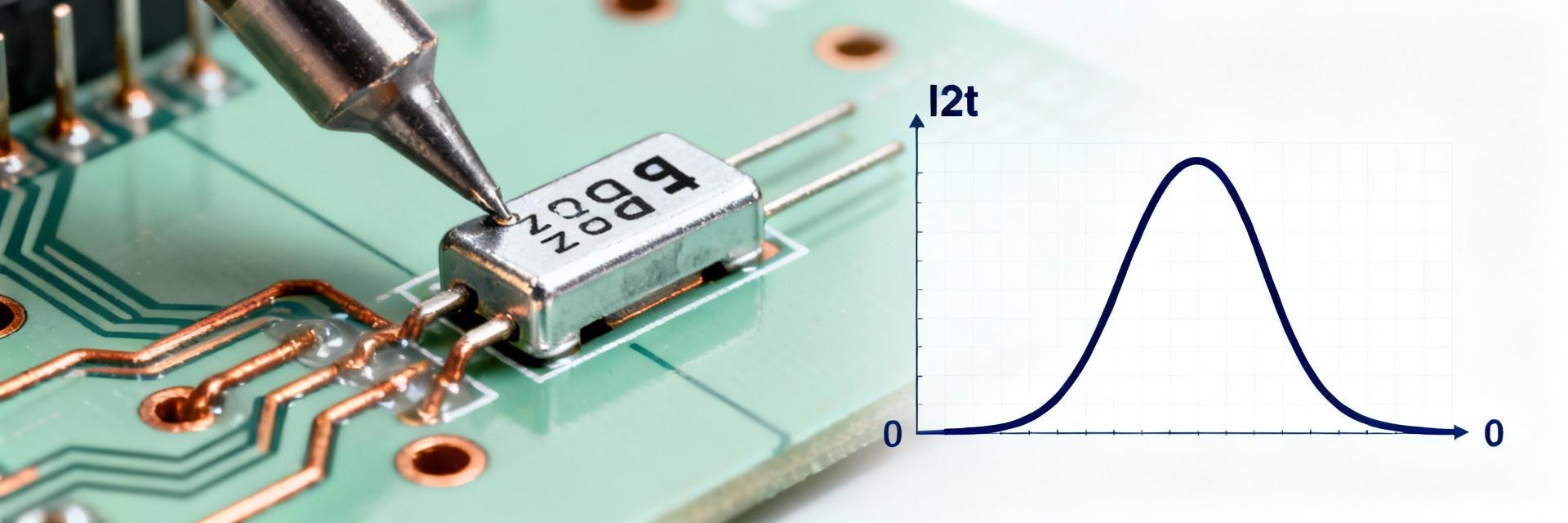
Visual comparison: The high I2t value of the 0452003.NRL provides superior inrush ride-through capability compared to standard fast-acting fuses.
I2t: Definition, Units, and Practical Interpretation
Physics & Formula
Point: I2t is the integral of current squared over time. Evidence: I2t = ∫ I² dt (units A²·s). Example: A 10 A pulse lasting 0.2 s yields I2t = 10² · 0.2 = 20 A²s, which is at the margin for melting this fuse element.
Practical Margin Sizing
Point: Use measured waveforms for margin sizing. Evidence: Size for I2t such that nominal melting exceeds computed worst-case inrush. Explanation: For capacitive loads, use a safety factor of 1.5–2×; for motors, consider 2–3×.
Technical Specification & Test Matrix
| Parameter | Value |
|---|---|
| Rated Current | 3 A |
| Rated Voltage | 125 V AC/DC |
| Nominal Melting I2t | ≈ 20.16 A²s |
| Typical Cold Resistance | ≈ 0.034 Ω |
| Operating Temperature | −55°C to +125°C |
| Pulse Type | Amplitude | Duration | Temp | Mount Condition |
|---|---|---|---|---|
| Capacitor Charge (exp) | 8–12 A | 0.05–0.3 s | 25°C / 70°C | Standard copper |
| Motor Inrush (half‑sine) | 10–20 A | 0.05–0.25 s | 25°C / 85°C | Nearby heat sources |
Failure Modes & Field Data
- • Common Scenarios: Underestimated capacitor inrush, sequential surges (duty cycling), and elevated ambient temperature often lead to premature openings.
- • Symptoms: Intermittent opens during startup, visible thermal damage, and increased resistance after thermal cycling.
- • Interpretation: Correlate oscilloscope captures with failed units to isolate I2t-driven faults from steady-state overloads.
Test Methods & Verification
Lab Setup: Use a programmable pulse current source and a high-bandwidth current probe. Apply representative pulse shapes (half-sine or exponential).
Pass/Fail: Criteria tie to nominal melting I2t and statistical spread. Record both melting and clearing I2t to set production test limits.
Design Practices & Case Study
Case Study: Power Module Remediation
Problem: A module with large capacitance experienced intermittent opens. Startup pulses measured 12 A peak (~0.18 s) → I2t ≈ 25.9 A²s, exceeding the 20.16 A²s rating.
Solution: Implementing a soft-start pre-charge reduced peak current to 6–7 A. Moving the fuse to a cooler PCB area and increasing copper pour for heat dissipation eliminated the failures.
Circuit Mitigation
Prefer soft-start, NTC thermistors, or pre-charge sequencing to reduce energy before up-sizing the fuse.
Layout Optimization
Use generous copper pours, keep away from hot ICs, and ensure proper pad geometry for the nano2 footprint.
Frequently Asked Questions
Engineer's Selection Checklist
- ✅ Compute worst-case inrush waveform and I2t.
- ✅ Apply ambient and enclosure thermal derating.
- ✅ Verify footprint (nano2/2410) and land pattern.
- ✅ Assess cold resistance impact on circuit efficiency.
- ✅ Maintain 1.5–3× safety margin on nominal I2t.
- ✅ Perform pre-deployment QA startup tests.
Summary: The 0452003.NRL is a 3 A slow‑blow SMD fuse with nominal melting I2t ≈ 20.16 A²s. Accurate I2t interpretation, measured inrush waveforms, and proper thermal design are essential to prevent false trips.
Keywords: 0452003.NRL, SMD Fuse, I2t Calculation, Slow-blow Fuse, Nuisance Tripping, Circuit Protection Engineering.
