Core Insight: Recent datasheet aggregations and distributor listings indicate the 37-way APD endbell family is widely listed and commonly chosen for sensor and industrial circular connector assemblies.
Evidence: Multiple independent inventory records show frequent stocking and cross-listings.
Explanation: This prevalence makes precise confirmation of fit and sealing essential for designers and buyers who must avoid field failures.
Technical Breakdown: This article breaks down the 044-8597-000 endbell specs and compatibility so engineers can confirm fit quickly.
Evidence: The summary below synthesizes mechanical, material, and installation data drawn from standard APD-series documentation.
Explanation: Use this as a rapid-reference—044-8597-000 specs focus on dimensions, sealing, and interchange rules.
Product Overview & Intended Use
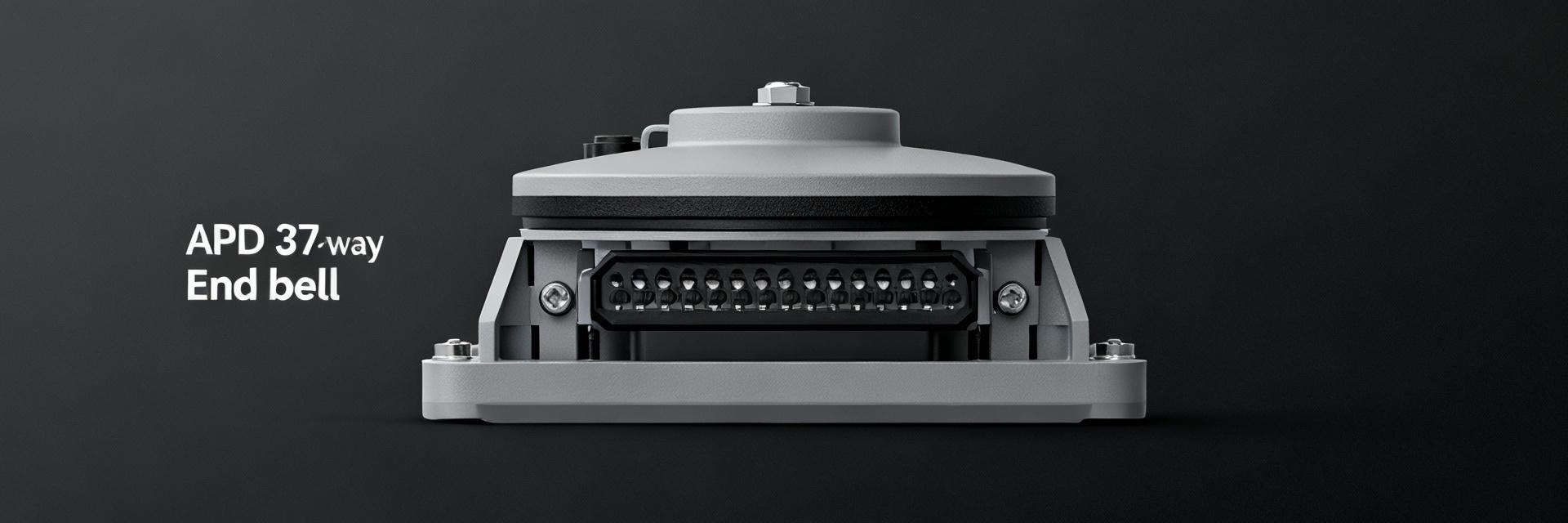
What the 044-8597-000 Endbell is and Common Applications
Point: The endbell is the cable-exit and strain-relief component for APD 37-way circular connectors.
Evidence: APD-series layouts show the endbell locates at the cable side, providing mechanical support, a sealed cable exit, and a mating surface to the connector shell. Explanation: Typical uses include industrial sensors, small actuator housings, and panel-mount assemblies.
Key Differentiators (Material, Finish, Color)
Point: Material and finish determine environmental suitability and longevity.
Evidence: Typical endbells in this class use glass-filled PA66 (nylon) with UV- and chemical-resistant additives. Explanation: This yields operating ranges from -40°C to ~95°C and improves resistance to oils and cleaners.
Full Technical Specifications
Mechanical Dimensions & Tolerances
Point: Accurate mechanical dimensions are the primary determinant of interchangeability. Evidence: Common listings show a nominal outer cable-exit face ~27 mm (1.06 in); typical machining tolerances are ±0.3 mm (±0.012 in).
| Parameter | Value | Unit | Tolerance |
|---|---|---|---|
| Outer Face Diameter | 27 | mm | ±0.3 |
| Cable Exit Angle | 180 | degrees | — |
| Recommended Panel Cutout | 1.06 | in | ±0.012 |
Materials, Thermal & Environmental Ratings
Point: Material selection and sealing features define long-term performance.
Evidence: Designs include an elastomer O-ring and a molded glass-filled nylon body, offering IP54–IP67 level protection. Explanation: Confirm operating temperature and UV resistance per manufacturer datasheet for demanding deployments.
Compatibility Matrix: Mating Parts & Shell Sizes
Mating Connector Types
| Connector Variant | Feature Fit |
|---|---|
| APD 37, Standard Shell | 180° Exit, O-ring Bore |
| APD 37, Thin-panel | Requires Spacer/Backing |
Cable OD & Strain Relief
Point: Cable diameter drives grommet selection.
Evidence: Compatible cable OD ranges span 6–12 mm (0.24–0.47 in). Explanation: Choose correct grommet orientation to minimize bend radius stress around the 37-contact arrangement.
Installation, Sealing & Testing Best Practices
! Step-by-Step Installation Checklist
- Inspect: Check endbell and O-ring for surface damage or debris.
- Measure: Confirm cable OD and select the appropriate grommet.
- Route: Guide conductors; seat grommet and endbell firmly.
- Tighten: Hand-tighten + 1/8 turn (consult torque specs for final).
Post-Installation Tests
Point: Post-install tests validate assembly reliability.
Method: Perform a bubble or pressure decay leak test (5–15 psi / 35–100 kPa), continuity checks, and insulation resistance checks per circuit.
Real-World Scenarios & Troubleshooting
Sourcing & Selection Guide
Quick Part-Selection Checklist
- ✓ Confirm APD 37 shell size and thread form
- ✓ Verify cable OD and grommet size
- ✓ Confirm color/version and O-ring presence
- ✓ Check material compatibility and lead-time
Search & Buying Tips
Use combined descriptors like "044-8597-000 endbell APD 37-way black". Request manufacturer datasheets early to shorten procurement cycles and ensure interchangeability.
Frequently Asked Questions
How to confirm 044-8597-000 endbell fitment? +
What tests verify sealing for a 37-way endbell? +
When is substitution of an endbell versus full connector swap required? +
Summary
The 044-8597-000 endbell is a purpose-built component for APD 37-way circular connector assemblies and requires dimension, cable OD, and sealing verification before interchange. Standardized form factors and widespread listings make it common in sensor and panel assemblies. To ensure reliable operation, measure existing parts, use the selection checklist, and run sealing and continuity tests before final deployment.
