Designers often face nuisance opens, failed certifications, or board damage when choosing tiny SMD fuses. The 043802.5WRA is a compact 0603 solution that addresses space-constrained power protection needs. This guide explains how to select & use the 2.5A fuse with clear checks—electrical match, PCB/assembly compatibility, and verification tests—so teams can avoid common pitfalls and get reliable in-field performance.
Background: What the 043802.5WRA 0603 SMD Fuse Is and Where It Fits
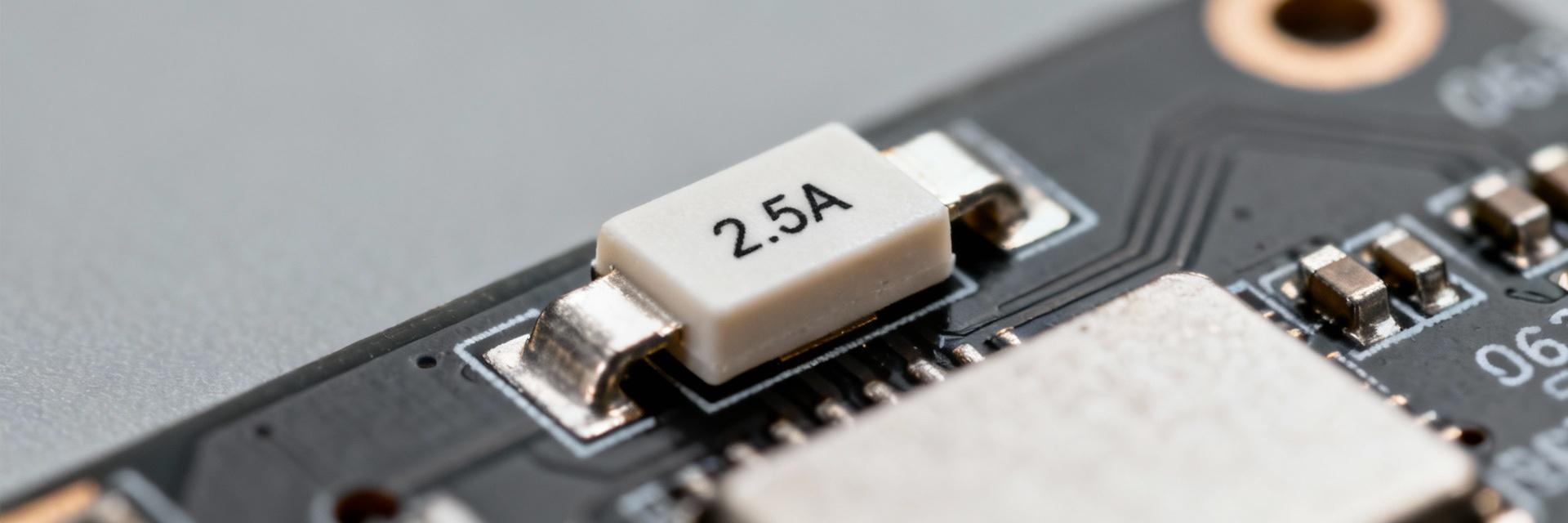
Point: The 043802.5WRA is a fast-acting 0603 surface-mount fuse rated nominally at 2.5A for low-voltage DC and specified AC ranges.
Evidence: Datasheet entries list rated current, voltage, interrupt capacity, case size (0603 / 1608 metric), and typical cold resistance.
Explanation: These specs define where the part fits—small portable electronics, module input rails, and compact telecom or automotive subassemblies where automated placement and minimal board real estate are priorities.
Key Electrical and Physical Specs to Know
Critical specs determine suitability. Typical values include rated current 2.5A and voltage rating up to common low-voltage system levels.
| Spec | Typical Value | Why it Matters |
|---|---|---|
| Rated Current |
2.5A
|
Defines continuous load allowed |
| Package | 0603 (1608 metric) | Space & placement constraints |
| Blow Type | Fast-acting | Protects sensitive parts; may nuisance-open |
| Interrupt Rating | Limited | Must exceed available fault energy |
Typical Applications and Design Contexts
0603 fuses excel where space and automated assembly matter. Common uses include input rails on compact sensor boards, telecom modules, and distributed power on small PCBs. Choose 0603 when PCB area and low thermal mass are priorities.
Data & Performance: Interpreting Selection Specs
Time-Current Curves
Read curves to ensure expected surges (inrush) do not cause nuisance opens. Rule-of-thumb: continuous current should generally be ≤ 70–85% of rated current depending on thermal conditions.
PCB & Assembly
Use vendor ECAD footprints and follow reflow limits. For automotive/industrial use, ensure vibration and thermal cycling qualifications are met to avoid internal damage.
How to Select the Right 043802.5WRA
Match Electrical Needs
Apply simple formulas: Rated Current ≥ Continuous Load / Derating Factor. Confirm blow time at surge current is greater than expected inrush duration. Add soft-starts if inrush is long.
Constraints & Trade-offs
Smaller packages reduce interrupt capability. Use a decision matrix to balance board space, fault energy, and sensitivity of protected circuitry before finalizing the 0603 form factor.
How to Install & Use on PCB: Best Practices
- Mounting: Verify footprint matches manufacturer ECAD to prevent tombstoning.
- Soldering: Follow reflow temperature/time limits strictly; excess heat stresses the fuse element.
- Testing: Implement bench current-ramp tests and thermal cycling to reveal marginal designs.
Real-world Use Cases & Common Failure Modes
Success Scenarios
Small sensor modules and multi-rail PCBs benefit from 0603 protection where fault energy is modest and space is at a premium.
Failure Prevention
Prevent nuisance opens by revising layout for heat dissipation and validating assembly reflow profiles.
Quick Pre-order Checklist
- ✔ Confirm system voltage vs datasheet.
- ✔ Request ECAD/3D files.
- ✔ Order samples for I²t testing.
Key Summary
- • 2.5A Fast-acting 0603 design.
- • Ideal for space-limited DC rails.
- • Match inrush/derating carefully.
