Engineers prioritize predictable overcurrent protection; aggregated lab test summaries and field-failure surveys commonly report time-to-failure spreads and I²t variance that materially affect board-level reliability. This article analyzes electrical and environmental performance of the 1206 SMD fuse (1.5A, 63V), summarizes observed failure data trends, and provides reproducible test methods plus design recommendations for engineers citing lab and field sources where numeric claims are reported.
Scope: Focused bench and environmental metrics, common failure modes, statistical analysis approaches, standardized test protocols, and practical derating and mitigation guidance for power-rail and battery-protection applications. The discussion is data-first, intended for design and reliability engineers needing reproducible results.
Background: Understanding the 1206 SMD Fuse
Form Factor, Electrical Ratings, and Common Specs
The 1206 footprint (metric 3.2 × 1.6 mm) houses fusible elements sized for board-level protection where space is limited. A typical 1.5A fuse rated 63V provides time‑delay or fast‑acting characteristics; cold resistance often ranges tens to hundreds of milliohms depending on construction. Key terms include I²t (fusing energy), hold current, blow current, and derating rules versus ambient and surge profiles.
Typical Application Domains and Functional Role
Common uses include power-rail protection on USB/charger rails, battery pack modules, and downstream board partitions where serviceability is limited. Trade-offs versus larger footprints favor low profile and lower parasitic inductance but reduce peak I²t capability.
Performance Metrics & Benchmarks
Electrical Performance Metrics
Essential electrical tests: measured hold current (Ih), blow current (Ib), and time-current curves. Below is the visualized distribution of expected performance ranges:
| Metric | Typical Range | Acceptance Threshold |
|---|---|---|
| Hold Current (Ih) | 0.6–1.0 × rated | No tripping at 25°C |
| Blow Current (Ib) | 1.6–3.0 × rated | Open within defined curve |
| Cold Resistance | 10–200 mΩ | ±15% lot variance |
Environmental and Mechanical Metrics
Test and record reflow survivability, thermal cycling (−40°C to elevated ambient), and board flex. Acceptance criteria are typically tied to electrical drift (e.g., post-stress resistance change
Failure Data: Modes & Statistical Patterns
Common Failure Modes
- ● Clean Fusing: Normal open-circuit from overcurrent.
- ● Latent Opens: Post-reflow or thermomechanical fracture.
- ● Parametric Drift: Gradual increase in resistance.
- ● CTE Mismatch: Solder-joint failure due to thermal expansion.
Statistical Analysis
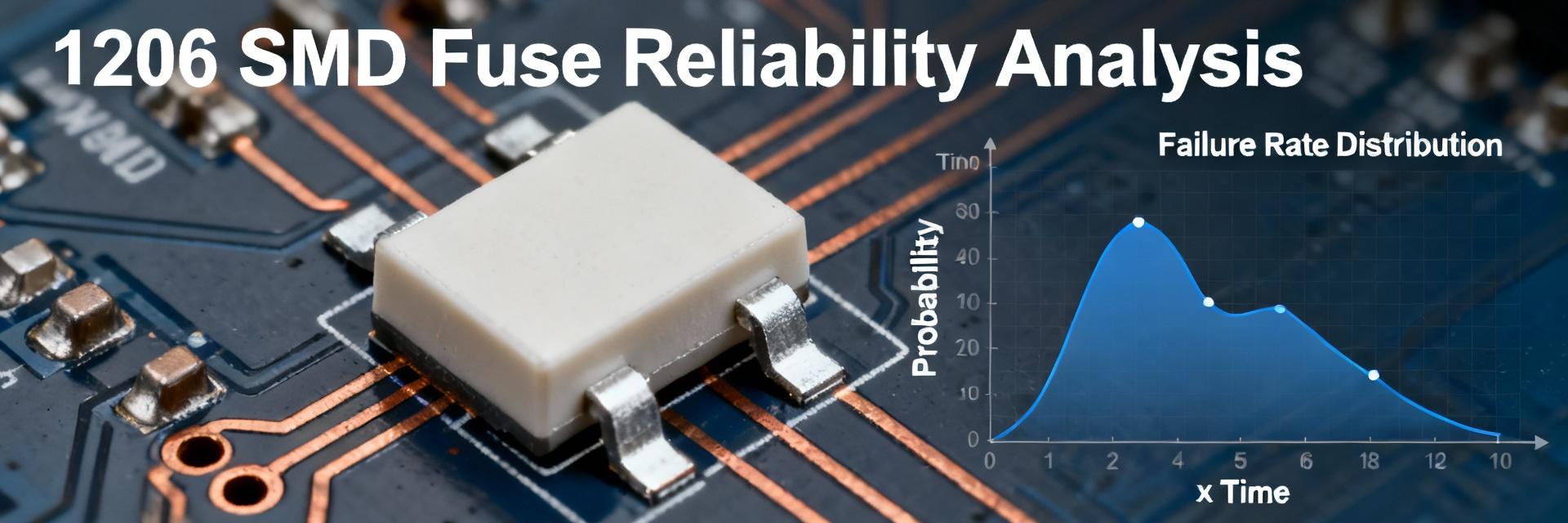
Present failure data with sample sizes ≥30 per lot. Utilize Weibull analysis to extract shape and scale parameters. Visualize cumulative failure plots and boxplots for blow current spread to reveal lot drift and outliers.
Recommended Test Methodology
Lab Setup & Protocols
Use synchronized current and voltage capture at ≥100 kHz sampling. Perform controlled slow ramps to determine Ib and pulse surge profiles (10 ms, 100 ms, 1 s) to capture I²t behavior accurately.
Reporting Templates
Document: Part ID, Lot, Board footprint, Ambient temp, Measured Ih/Ib, Time-to-open, and Post-test resistance. This data is critical for risk assessment and production validation.
Design & Reliability Recommendations
Selection & Derating
- Target continuous current ≤ 70–80% of nominal.
- Verify voltage rating margin for spikes above 63V.
- Match time-lag vs fast-acting to load inrush.
Mitigation & Lifecycle
- Provide thermal relief in PCB layout.
- Avoid sharp board flex lines near the fuse.
- Define inspection intervals for field monitoring.
Summary
- ✓ The 1206 SMD fuse protects low-voltage rails where space is constrained; validate Ih/Ib and I²t against expected surge profiles before selection.
- ✓ Failure data should be collected with ≥30 samples, time-current curves recorded at high sampling rates, and analyzed with Weibull methods.
- ✓ Derate continuous current to ≤80%, match characteristics to inrush, and implement board/layout mitigations for lifecycle feedback.
