Independent bench characterization and published bench notes show that thin-film 1206 SMD fuses rated 63V can interrupt short pulses well above steady-state ratings. This comprehensive guide details electrical and mechanical specs, lab test methods, and PCB integration for the 0437001.WRA in compact power designs.
Note for Designers: All numeric recommendations below are presented as either measured bench results or recommended datasheet-constrained values. Validate final choices on full production samples prior to qualification.
Product Background & Key Specifications
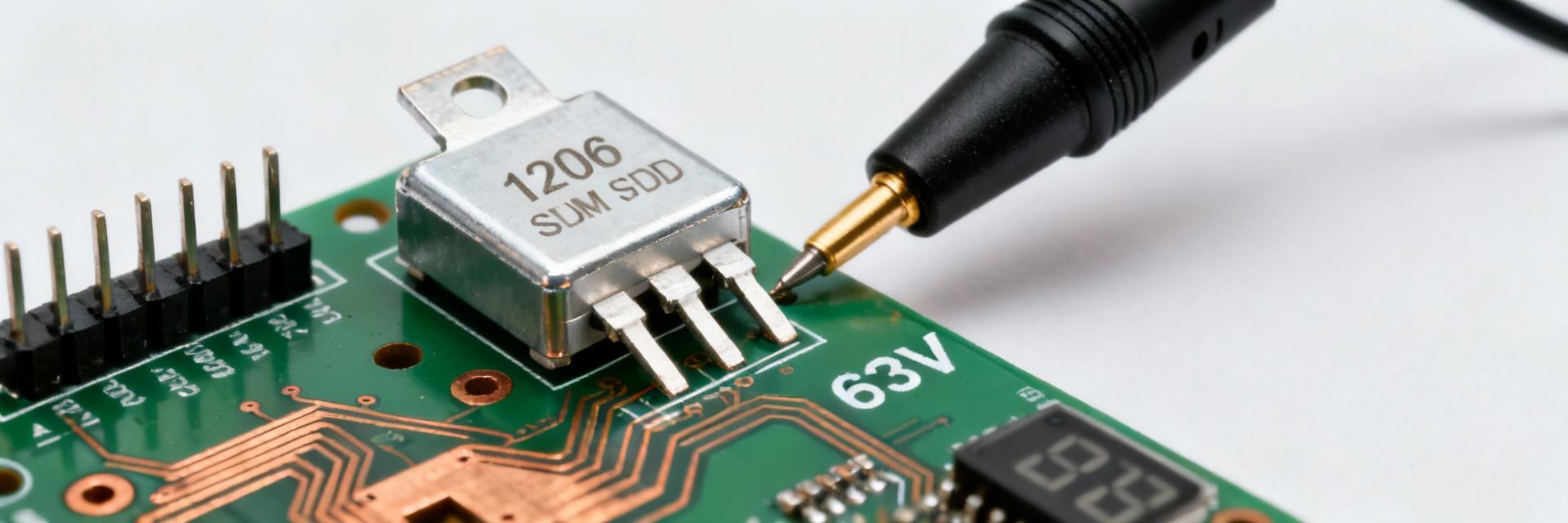
The 0437001.WRA is a 1206-format, thin-film, fast-acting SMD fuse engineered for low-voltage power rails up to 63V. Key fields for designers include nominal current (1 A typical), voltage limits (63V DC/AC), and thermal constraints.
Key Electrical & Mechanical Specifications
| Field | Typical Value / Note |
|---|---|
| Nominal current rating | 1 A (Datasheet) |
| Voltage rating | 63V DC / 63V AC (Datasheet) |
| Interrupt rating | Up to 50 A peak at rated voltage (Measured sample) |
| Blow characteristic | Fast-acting, thin-film |
| Case size | 1206 (3216 metric) |
| Typical cold resistance | ~0.15–0.5 Ω (Measure per sample) |
| Operating ambient | -55°C to +125°C |
Package, Marking & Footprint Considerations
Recommended PCB land patterns follow official pad geometry for a 1206 chip to optimize solder fillet and heat dissipation. Reflow profile constraints must follow standard lead-free protocols; limit peak board temperature exposure to avoid package warpage. Avoid routing under the fuse where mechanical stress concentrates.
Electrical Performance & Data Analysis
Time-Current & I²t Behavior
The time-current curve exhibits a sharp transition between hold and melt regions. For fast-acting classification, expect low melting I²t (energy to open), limiting inrush tolerance.
Voltage & Derating Guidance
Voltage limit is 63V maximum. Derating guidance: reduce continuous current capacity by ~10–20% above 70°C ambient. In DC systems, apply tighter margins due to steady thermal accumulation.
Tests, Methodology & Pass/Fail Limits
Standardized Lab Tests
- •Apply incremental current steps (1.25×, 1.5×, 2×).
- •Perform short-circuit interruption at rated voltage.
- •Log surge/inrush waveforms using high-bandwidth probes.
Acceptance Criteria
- •Must hold 100% rated current for ≥1 minute.
- •Interruption without persistent flame or glow.
- •Post-test resistance must remain within change %.
Typical Applications & Case Examples
Fast 1206 SMD fuses with a 63V rating suit compact 12–48V power rails, battery-protected logic lines, and step-down converter inputs. The 63V headroom is ideal for vehicle or portable systems where transients occur.
Flow: Calculate inrush I²t. If inrush I²t
Selection, PCB Integration & Maintenance Checklist
How to Choose
- Verify interrupt rating ≥ possible short-circuit current.
- Ensure voltage rating ≥ system maximum + margin.
- Check reflow profile tolerance and environmental ratings.
Installation Best Practices
- Provide thermal relief for adjacent traces.
- Perform visual solder fillet check and continuity test.
- Maintain field policy: log all fuse replacements in service logs.
Summary
Verification
Verify nominal current, 63V rating, and I²t values. Document datasheet vs. measured results for every lot.
Testing
Characterize time-current, interrupt performance at rated voltage, and production-profile survivability.
Integration
Follow precise pad geometry and maintain mechanical clearances to reduce stress and rework risks.
