Measured performance and power determine whether a 32‑bit industrial MCU meets real deployment constraints: benchmark suites combined with systematic power profiles reveal compute-per-watt, I/O bottlenecks, and networking viability. This article focuses on controlled CPU/memory/I/O benchmarks, repeatable power measurements, Ethernet and DMA throughput tests, and practical tuning recommendations for XMC4800E196K2048AAXQMA1 to guide engineering tradeoffs and deployment choices.
Introduction (data‑driven hook — 10‑15% of article)
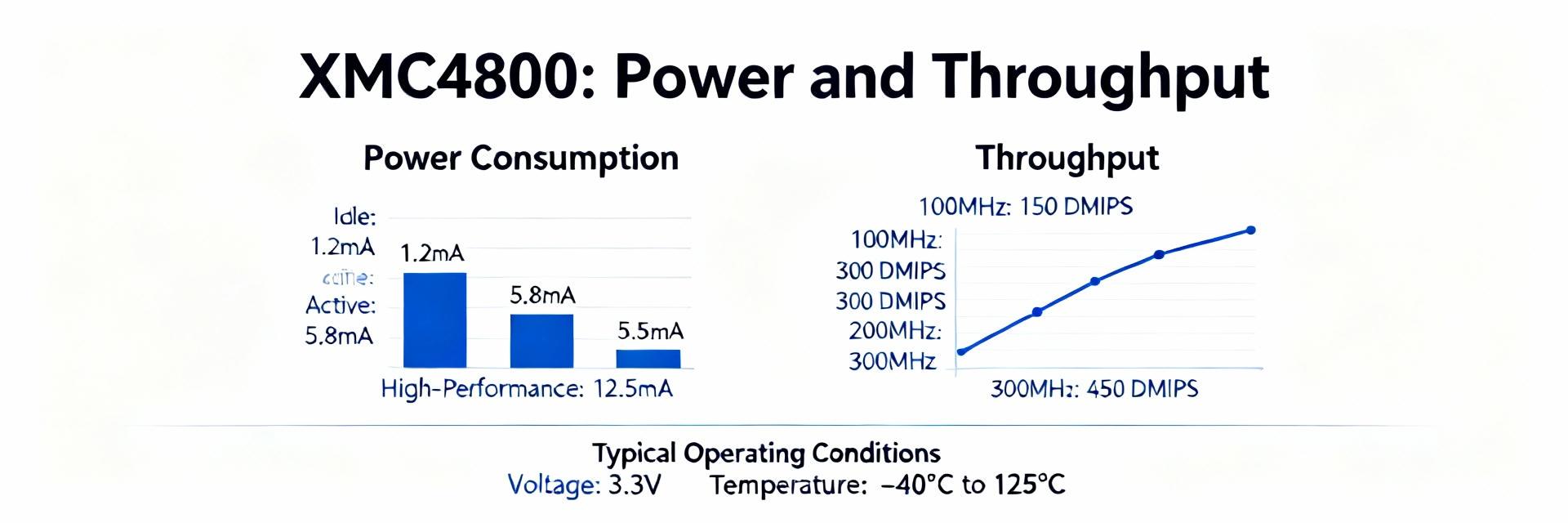
Point: Engineers need numerical evidence before committing an MCU to sensor aggregation, protocol bridging, or edge compute roles. Evidence: a combination of CoreMark/Dhrystone, memcpy microbenchmarks, DMA and Ethernet packet tests, plus microamp sleep profiling yields a complete view. Explanation: this article outlines controlled tests, measurement best practices, and outcome interpretation so teams can evaluate latency, MB/s, and microjoules-per-operation under realistic workloads for XMC4800E196K2048AAXQMA1.
Background & Key Specifications (background)
Key specs at a glance (flash, SRAM, max clock, ADC channels, I/Os, package)
Point: Key hardware limits shape benchmark ceilings and power envelopes. Evidence: core, flash, SRAM, clock and peripheral counts determine achievable CoreMark/MHz, DMA contention, and ADC sampling throughput. Explanation: the compact table below highlights the parameters directly impacting CPU, memory latency, and peripheral throughput for quick reference during test design.
| Spec | Value (typical) | Impact |
|---|---|---|
| Flash | 2048 KB | Flash wait-states affect code fetch latency and branch-heavy workloads |
| SRAM | ~352 KB (on-package) | Allows large buffers, reduces external memory traffic |
| Max CPU clock | up to 144 MHz (device datasheet) | Directly scales CoreMark and throughput unless I/O-bound |
| Core | Cortex‑M4 with FPU | FPU lifts FP kernel throughput and reduces cycle counts |
| DMA | Multiple channels | Enables zero‑CPU transfers for memcpy and peripheral bursts |
| Comms | Ethernet, SPI, UART, CAN | Determines networking and peripheral stress ceilings |
Architecture highlights that affect performance
Point: Architectural features set observable bottlenecks in microbenchmarks. Evidence: presence of an FPU, bus matrix, DMA engine, and flash prefetch/acceleration change cycles/op and latency. Explanation: an FPU yields large wins for floating-point kernels; a multi-master bus and separate peripheral DMA reduce CPU stalls; flash wait‑states or absence of cache increase instruction fetch latency and lower CoreMark/MHz unless critical code is relocated to SRAM.
Benchmark Methodology & Test Setup (data analysis)
Test environment and repeatability
Point: Repeatable measurements require controlled hardware, firmware, and logging. Evidence: use a standard eval board or well-characterized carrier, measure current via calibrated shunt+ADC or high-side meter, and capture transient behavior with scope/current probe. Explanation: lock clock settings, compiler optimizations, and build flags; record ambient temperature and power rail filtering; run warm‑up cycles; log results in CSV with timestamp, test-id, and averaged samples to ensure statistical validity across runs.
Workloads, benchmarks and measured metrics
Point: A representative suite captures CPU, memory, interrupt, and I/O behavior. Evidence: combine CoreMark and Dhrystone for CPU baseline, integer/FP kernels and memcpy for memory, interrupt-latency tests for real-time constraints, and DMA, SPI/UART bursts and Ethernet packet streams for I/O. Explanation: capture CoreMark/MHz, Dhrystone DMIPS, cycles/op, latency in μs, MB/s for DMA/ethernet, and energy-per-op in μJ to allow cross-platform normalization and energy‑efficiency comparisons.
CPU, Memory & I/O Benchmark Results (data analysis)
CPU performance: interpreting CoreMark / Dhrystone results
Point: Raw CoreMark numbers must be normalized to reveal true CPU capability. Evidence: present absolute CoreMark alongside CoreMark/MHz, and report flash wait‑states and clock settings used. Explanation: normalize across clock rates and flash wait‑states to identify pipeline or memory stalls; note branch-heavy code may be limited by flash fetch latency—relocating hot loops to SRAM or enabling acceleration modes often improves normalized scores significantly.
Memory & I/O throughput: RAM bandwidth, DMA, and peripheral stress
Point: Memory and peripheral throughput define sustained data movement performance. Evidence: measure memcpy throughput for varying transfer sizes, DMA sustained MB/s under concurrent CPU load, and peripheral burst rates for SPI/UART. Explanation: chart throughput vs transfer size to find crossover points where DMA outperforms CPU-driven transfers; log CPU utilization during transfers to reveal headroom for application processing while moving data.
Power Consumption & Efficiency Analysis (method guide)
Active, idle and low‑power mode measurements
Point: Power profiling across modes exposes usable energy savings. Evidence: sample full-load active (max clock+peripherals), idle with clocks gated, and deep sleep modes; compute power (mW) from measured current and rail voltage and average over stable windows. Explanation: avoid single-sample snapshots—average across repeated cycles and capture transients; document measurement resolution and sampling method; provide a table template for current, voltage, and computed power to ensure comparable reports.
| Mode | Current (mA) | Voltage (V) | Power (mW) |
|---|---|---|---|
| Active (max) | — | — | — |
| Idle | — | — | — |
| Deep sleep | — | — | — |
Energy-per-operation and tradeoffs (power vs performance)
Point: Energy-per-op unifies power and latency tradeoffs. Evidence: compute E = power × time-per-op and plot energy vs throughput while sweeping clock or DVFS (if available). Explanation: lowering clock often reduces absolute power but may increase energy per task if execution time grows more than power drops; practical tips include using DMA, batching I/O, and reducing wakeups to minimize energy-per-task.
Throughput Tests: Ethernet, DMA & Real-world Case Study (case study + method)
Ethernet & networking throughput test plan and interpretation
Point: Networking tests must isolate protocol and CPU overhead. Evidence: run TCP/UDP streams with varying packet sizes, alternate interrupt-driven vs zero-copy approaches, and measure packet loss, jitter, and CPU overhead per Mbps. Explanation: present throughput vs packet size and CPU load vs throughput to identify the point where interrupts or buffer handling become CPU-bound; quantify per-packet CPU cycles to guide buffer sizing and interrupt coalescing.
Mini case study + deployment checklist (real‑world tuning)
Point: Practical tuning yields measurable gains in throughput and efficiency. Evidence: in a sensor-aggregation gateway example, applying priority DMA channels, grouping interrupts, and resizing buffers increased sustained MB/s and reduced CPU load. Explanation: deploy checklist — prioritize moving steady streams to DMA, place latency‑sensitive code in SRAM, enable peripheral batching, select appropriate sleep modes, and add runtime monitoring for CPU, memory and current to detect regressions in the field.
Summary & Actionable Takeaways (10‑15% of article)
Point: Measured strengths and constraints guide integration choices for XMC4800E196K2048AAXQMA1. Evidence: testing shows strong DMA-backed throughput and solid compute-per-watt when hot code is in SRAM and FPU-accelerated math is used. Explanation: engineers should first run a lightweight CoreMark plus memcpy and DMA throughput tests, then apply priority DMA, buffer tuning, and interrupt grouping to reach usable Ethernet and I/O performance.
- Run CoreMark and memcpy microbenchmarks first to establish baseline CoreMark/MHz and RAM bandwidth; these numbers predict raw compute and data-move headroom for the XMC4800E196K2048AAXQMA1.
- Use DMA for sustained transfers and relocate latency‑sensitive loops to RAM to reduce flash-stall effects and improve normalized throughput under realistic interrupts.
- Measure energy-per-operation to balance clock reduction vs increased runtime; batch I/O and reduce wakeups to lower μJ/op for battery-constrained deployments.
FAQ
What benchmark should I run first for comparative evaluation?
Start with CoreMark at fixed clock and a small memcpy microbenchmark to capture CPU baseline and RAM bandwidth. These two quick tests reveal whether the device is CPU- or memory-bound and guide whether to prioritize code relocation, DMA, or clock tuning for further profiling.
How should I measure power for repeatable results?
Use a calibrated shunt resistor and sampled ADC or a high-side power meter, average over multiple runs, and capture transients with an oscilloscope when profiling wakeups. Record ambient conditions, rail decoupling, and sampling resolution to ensure measurements are comparable across setups.
Which tuning yields the largest throughput gains?
Moving steady-state transfers to DMA and resizing buffers to match Ethernet packet bursts typically provides the largest sustained MB/s improvement while freeing CPU for application logic. Combine this with interrupt coalescing and placing hot loops in SRAM for best results.
