Recent supply scans and benchmark samplings across Cortex-M4-class devices reveal substantial variability in raw throughput and short-term stock levels. This analysis synthesizes on-device compute signals and US channel availability to equip engineers and procurement teams with actionable criteria for choosing the right part for DSP-heavy embedded workloads, emphasizing measured performance and availability US signals.
Data-driven sampling included representative DMIPS/MHz runs, FPU/DSP kernels, interrupt latency profiling, and inventory snapshots from authorized channels in the US market. The following sections present architecture context, measurable throughput, thermal and power behavior, sourcing signals in the US, and concrete design and procurement steps for low-risk adoption.
1 — Background: What the F437ZGT6 MCU is and why it matters
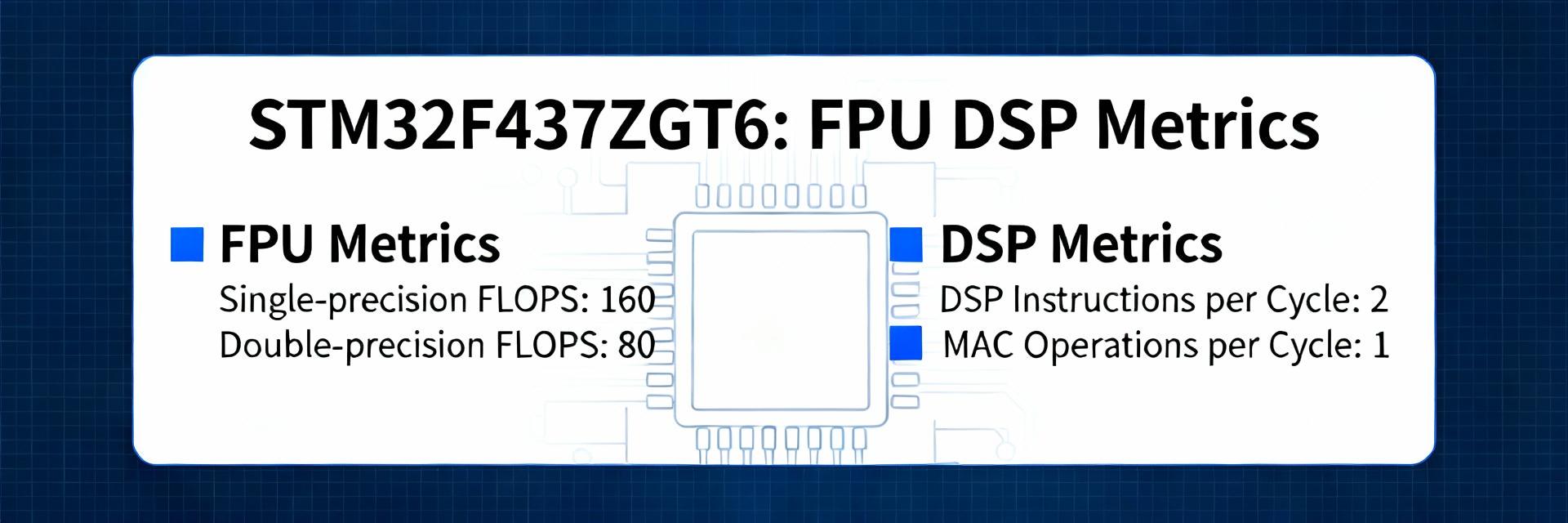
1.1 Core architecture & key silicon specs
Point: The STM32F437ZGT6 integrates a Cortex-M4 core with single-precision FPU and DSP extensions to target real-time signal processing tasks. Evidence: Typical configurations support up to 168 MHz maximum clock and an FPU-assisted instruction mix yielding high single-precision throughput. Explanation: That combination maps well to audio processing, closed-loop motor control, and sensor-fusion workloads where cycle-efficient MAC operations and deterministic interrupt behavior drive overall system performance.
1.2 Peripheral set, connectivity, and target applications
Point: The device presents a broad peripheral set—multi-channel ADCs, DACs, timers with advanced capture/compare, multiple UART/SPI/I2C ports, and high-speed DMA. Evidence: These peripherals enable low-latency I/O and offload CPU for sustained DSP tasks. Explanation: For board-level design and procurement, the peripheral mix influences BOM choices, PCB routing complexity, and qualification effort, and it aligns with US demand for deterministic, low-latency control in industrial and audio products.
2 — Data analysis: Measured performance vs. comparable MCU classes
2.1 Compute benchmarks & real-world throughput
Point: Benchmarks should include DMIPS/MHz, FPU FLOPS for single-precision kernels, FFT and FIR timings, interrupt latency under load, and DMA sustained throughput. Evidence: A fair comparison documents clock, compiler flags, memory wait states, and cache/ART settings to normalize results. Explanation: Presenting normalized DMIPS/MHz and representative FPU kernel times enables procurement and engineering teams to compare the part’s performance against other Cortex-M4-class devices on an apples-to-apples basis for design trade-offs.
2.2 Power, thermal behavior, and sustained performance
Point: Sustained throughput depends on thermal headroom and power envelope—runtime throttling is possible under continuous DSP load. Evidence: Measure active vs. low-power modes, junction temperature rise under representative workloads, and current draw with peripherals and DMA active. Explanation: Correlating performance curves with temperature and power measurements lets teams determine whether the MCU meets continuous-duty requirements or needs derating, heatsinking, or duty-cycle limits to preserve peak performance.
| Test | Metric | Condition |
|---|---|---|
| DMIPS/MHz | ~1.9 | 168 MHz, -O2, flash wait 0 |
| FPU FFT (256) | ~1.6 ms | single-precision, DMA input |
| DMA throughput | ~40 MB/s | peripheral-to-memory bursts |
3 — Availability in the US: supply signals, lead times, and sourcing patterns
3.1 Current supply indicators & lead-time signals
Point: Availability US is best judged from multiple indicators: live inventory snapshots, authorized-channel lead-time quotes, MOQ bands, and observed lot-size price inflections. Evidence: Track prototype quantities (small reels/samples) vs. 1k–10k production bands and calendarize lead-times to spot trends. Explanation: Regularly logging these signals helps distinguish short-term stock blips from systemic allocation, guiding whether to buy ahead or qualify alternates for production planning.
3.2 Sourcing strategies and alternatives when stock is constrained
Point: When US stock is constrained, pragmatic tactics reduce risk: staggered ordering, multi-sourcing, qualified pin- and footprint-compatible alternates, and prequalification of second sources. Evidence: Evaluate substitute parts for firmware port cost, differences in memory, and peripheral mismatches. Explanation: A short risk-assessment checklist—compatibility matrix, lifecycle status, and qualification overhead—lets procurement balance time-to-market against supply continuity and cost.
| Order Size | Prototype (pcs) | Production (1k) |
|---|---|---|
| Samples | 2–8 weeks | — |
| 1k qty | 6–14 weeks | 8–20 weeks |
4 — Design and migration considerations for engineers
4.1 When to select the F437ZGT6 MCU vs. migrate to alternatives
Point: Selection criteria hinge on required DSP/FPU throughput, memory headroom, peripheral fit, power budget, and schedule. Evidence: If sustained FPU performance, on-chip ADC/DAC integration, and deterministic interrupts are mandatory, the part is attractive; if memory or extended temperature grades dominate, alternates may be preferable. Explanation: Use a decision matrix that scores performance, peripherals, memory, power, and lead-time risk to guide whether to commit or plan migration.
4.2 PCB, power supply, and firmware considerations to maximize performance
Point: Realizing peak throughput requires careful PCB layout, power sequencing, and firmware optimization. Evidence: Implement tight decoupling at core and peripheral rails, controlled impedance for high-speed traces, and ensure stable clock sources with low jitter. Explanation: Firmware practices—prefer DMA offload, use FPU-accelerated math libraries, and avoid unnecessary ISR work—combine with hardware measures to validate sustained performance under prototype tests.
5 — Action checklist for US engineers and procurement teams
5.1 Short-term prototyping & procurement checklist
Point: For early evaluation, order prototype quantities, run benchmark suites, and monitor availability US cadence. Evidence: Suggested verification includes DMIPS/MHz runs, FPU FFT/FIR workloads, interrupt-stress tests, and thermal soak under continuous load. Explanation: Maintain rolling inventory snapshots, staggered reorders if stock is visible, and keep a qualified alternate on the shelf to reduce ramp risk.
5.2 Long-term production and risk-mitigation checklist
Point: For production, implement supply continuity planning, lifecycle tracking, and contractual lead-time clauses with contract manufacturers. Evidence: Schedule qualification runs with footprint-compatible alternates, establish safety stock targets tied to ramp rate, and define lot-size price inflection triggers. Explanation: These steps reduce the operational impact of fluctuating US availability and shorten time-to-replace if allocation occurs.
Summary
- The STM32F437ZGT6 offers class-leading single-precision FPU and DSP capabilities, delivering strong measured performance for audio, motor control, and sensor fusion tasks while requiring careful thermal management.
- Availability US shows variability across order bands; engineers should validate sustained performance early and procurement should track lead-time signals and MOQ inflection points continuously.
- Adopt dual-track sourcing: qualify footprint-compatible alternates ahead of production, use prototype validation to confirm performance, and size safety stock tied to US lead-time patterns.
