Point: The 0420CDMCCDS-R47MC datasheet lists a compact, low‑inductance component suited to dense DC–DC designs. Evidence: Published figures show 0.47 µH inductance, approximately 14 mΩ DC resistance (DCR), a 4.40 × 4.20 mm footprint and a seated height near 2.00 mm. Explanation: These numbers position the part as a space‑efficient choice for point‑of‑load and buck converter chokes where low DCR and package density matter.
Point: This article translates the official datasheet and bench observations into actionable guidance for engineers. Evidence: It emphasizes measured curves, test methods and layout recommendations without naming suppliers, relying on the official datasheet as the reference. Explanation: The result is a practical, data‑driven review that helps teams evaluate this SMD component for tight power designs.
Background & Part Overview (type: background)
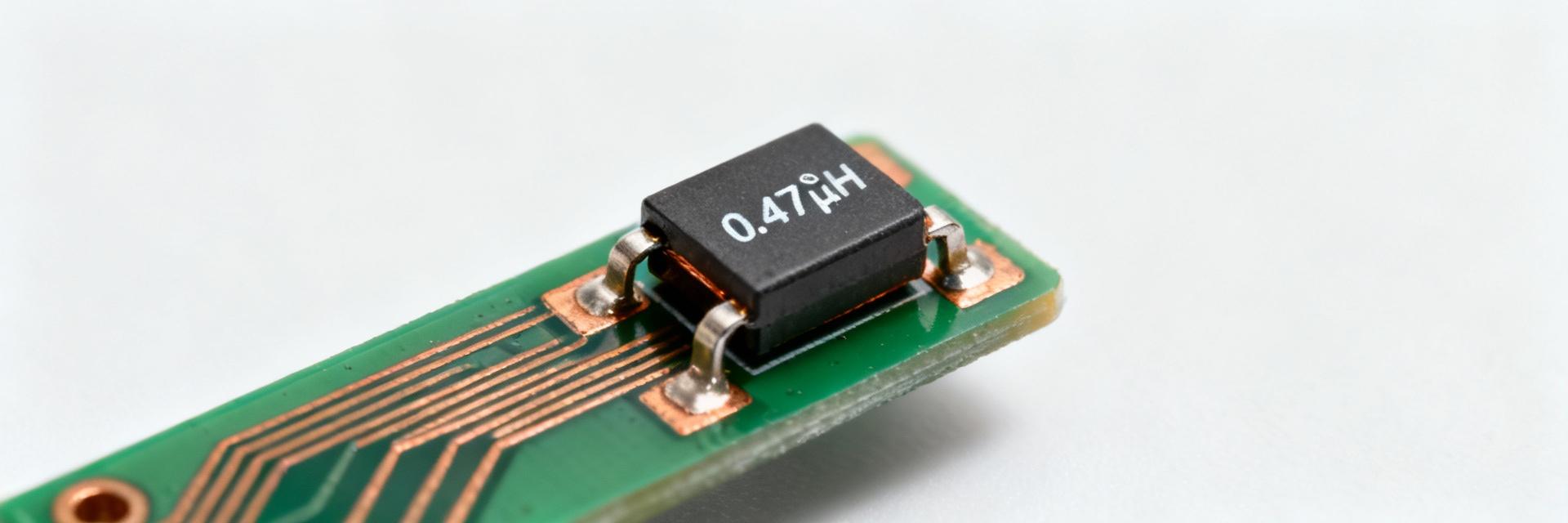
Part identity, naming and typical applications
Point: The part number encodes family and value details and targets power conversion roles. Evidence: The marking convention indicates an SMD power inductor family optimized for buck/boost regulators and point‑of‑load stages. Explanation: Typical circuit positions include input filtering near the VIN node and output choke duties immediately after the regulator’s switching node, where compact size and low DCR reduce I²R loss and voltage ripple.
Mechanical and packaging summary
Point: Mechanical parameters determine PCB real estate and soldering considerations. Evidence: Key dimensions are 4.40 × 4.20 mm footprint, ~2.00 mm seated height and about 0.18 g mass; recommended land patterns are in the official datasheet. Explanation: Designers should include a PCB footprint graphic, thermal vias where appropriate and solder fillet clearance notes to ensure reliable reflow and consistent electrical contact in high‑current layouts.
Full Electrical Specifications (type: data analysis) — include main keyword
Core electrical specs to present (must include a table)
Point: A concise spec table helps compare alternatives; values must be reported with test conditions. Evidence: The official 0420CDMCCDS-R47MC datasheet gives inductance, DCR and other key metrics at specified test frequencies and conditions. Explanation: Below is a practical summary table; designers must verify rated current, saturation current and SRF from the official datasheet and annotate test conditions when populating BOM documentation.
| Parameter | Value (typical / as specified) | Test condition / note |
|---|---|---|
| Inductance | 0.47 µH | Measured at manufacturer test frequency (see official datasheet) |
| Tolerance | See official datasheet | Specify % tolerance from datasheet |
| DC Resistance (DCR) | ~14 mΩ | Ambient temperature noted; measure with Kelvin leads |
| Rated current | Refer to official datasheet | Use saturation and temperature limits for rating |
| Saturation current (Isat) | Refer to official datasheet | Report L drop criterion (e.g., 10% drop) |
| SRF | Refer to official datasheet | Specify measurement method and fixture |
| Test frequency for L / Q | As per official datasheet | Label frequency and drive level next to values |
Environmental & reliability specs
Point: Environmental ratings constrain operating envelopes and assembly processes. Evidence: Typical datasheet entries include operating temperature range, moisture sensitivity level (MSL), halogen‑free/ROHS flags and storage limits. Explanation: Call out any reflow profile recommendations, temperature extremes and humidity limits; note any derating advised for elevated ambient or long‑term temperature exposure that could impact Isat or DCR stability.
Bench Test Data & Performance Summary (type: case/display) — include main keyword
Typical bench results and how to visualize them
Point: Measured curves reveal real‑world deviations from catalog values. Evidence: Present measured inductance versus frequency, L versus DC bias (saturation curve) and DCR as a function of temperature/current, and compare these to the official datasheet. Explanation: Charts that overlay datasheet curves and in‑house readings make deviations clear and help set acceptance tolerances for sample lots and incoming inspection.
Thermal behavior & power loss data
Point: Losses and thermal rise determine practical current handling. Evidence: Use measured DCR (≈14 mΩ) to compute I²R loss; for example, at 5 A the copper loss is I²R = 25 × 0.014 = 0.35 W. Explanation: Report ΔT versus current from thermal‑rise tests rather than relying on estimated thermal resistance; include a worked example calculation and note how PCB thermal vias and nearby copper areas alter temperature rise.
Measurement Methodology & Test Conditions (type: methods)
How inductance and DCR were/will be measured
Point: Consistent instrument selection and removal of fixture parasitics ensure repeatability. Evidence: Use an LCR meter or impedance analyzer with a Kelvin fixture, perform open/short compensation and measure L at the specified frequency and drive current. Explanation: Report measurement uncertainty, temperature during test and the number of samples; specify DC bias levels when reporting L under operating conditions to reflect converter currents.
Saturation and thermal test procedures
Point: Standardized procedures provide comparable Isat and thermal‑rise data. Evidence: Perform a DC current sweep to determine L drop with hold times long enough to reach thermal steady state, control ambient temperature and log readings at set cadence. Explanation: Define pass/fail criteria (e.g., L drop threshold for Isat) and derive derating curves that map allowable continuous current versus ambient temperature for system design.
Application Guidance & Selection Checklist (type: action recommendations)
PCB layout, EMI and magnetics best practices
Point: Layout decisions strongly affect EMI and thermal performance for an SMD power inductor. Evidence: Place the inductor close to the regulator switching node, minimize the switching loop area, use multiple vias for current return and keep sensitive traces away from high dV/dt nodes. Explanation: The part’s small 4.40 × 4.20 mm footprint and 2.00 mm height favor dense placement but require careful via planning and clearance to maintain thermal paths and control radiated emissions.
Selecting equivalents and procurement/validation checklist
Point: Equivalents must match electrical and mechanical constraints. Evidence: Match inductance, DCR, Isat, SRF, footprint and height, plus MSL and reflow compatibility when selecting alternates. Explanation: Pre‑production checks should include comparing datasheet curves, bench tests for L vs bias and thermal rise, solder joint inspection, and in‑circuit validation in the target converter to confirm transient and steady‑state behavior.
Summary
Point: The official 0420CDMCCDS-R47MC datasheet combined with targeted bench validation gives engineers confidence in compact converter designs. Evidence: Confirm DCR, inductance under bias and thermal rise in representative conditions before finalizing the BOM. Explanation: Use the datasheet as the baseline, validate samples under expected operating currents and ambient conditions, and iterate layout or part selection if thermal or saturation limits are reached.
Key summary
-
Compact low‑value inductor: At 0.47 µH and ~14 mΩ DCR, this SMD device suits tight point‑of‑load applications; always verify inductance under the converter’s DC bias to confirm usable L.
-
Thermal and saturation checks are essential: Compute I²R losses from measured DCR and run thermal‑rise tests on sample boards to determine real allowable continuous current for your layout.
-
Layout and validation matters: Match footprint and height for mechanical fit, include thermal vias where needed, and validate in‑circuit ripple and transient performance before committing to production.
