The HCPL-J312-500E delivers isolation ratings up to 3750 Vrms and common‑mode transient immunity on the order of 25 kV/µs, numbers that directly affect gate‑drive reliability in high‑voltage systems. This compact briefing provides a data‑first breakdown of the HCPL-J312-500E electrical specs and isolation data, practical verification procedures, PCB best practices, worked design examples, and a concise selection checklist.
Point: designers need measured, reproducible test steps and layout rules. Evidence: device datasheet lists Vf, If thresholds, output drive capability, Vrms and CMTI min specs as primary qualifiers. Explanation: the rest of this article focuses on those measurable items, how to record them, and how they translate to system margins for isolated gate drives and protection interfaces.
HCPL-J312-500E: device overview and typical uses
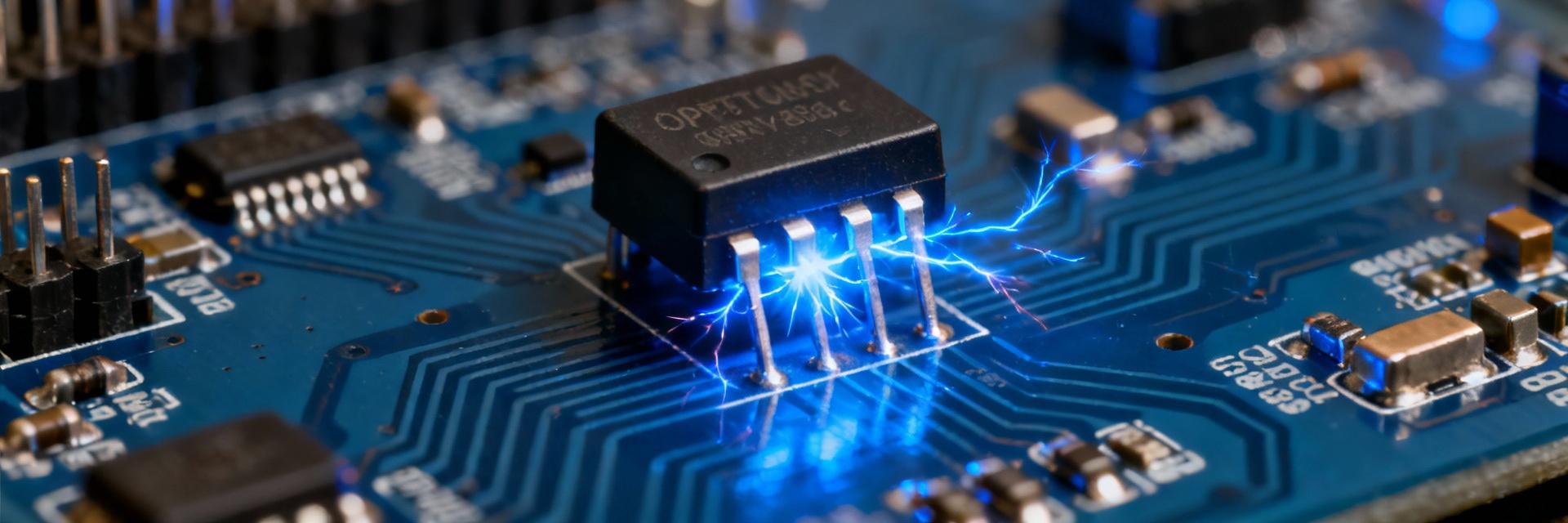
— Functional description
Point: the part is an LED‑to‑isolated photonic link with an output power stage; the input LED forward voltage and the output stage type define interface behavior. Evidence: the input requires a specified forward current for logic thresholds while the output can source/sink limited current to a gate resistor. Explanation: designers should treat the input as a current‑driven diode and the output as a drive element whose timing and current capability determine gate charge transfer and switching margins.
— Typical application domains and system roles
Point: common uses include isolated gate drives for IGBTs/MOSFETs, high‑voltage DC–DC converters, and protection signal interfaces. Evidence: isolation Vrms and CMTI are the decisive specs when the part sits between primary high‑voltage nodes and low‑voltage control. Explanation: in gate‑drive roles high Vrms rating protects long‑term dielectric integrity while high CMTI prevents false triggering during steep switching edges.
Key electrical specs: input, output and timing (use "electrical specs")
— Input/LED electrical characteristics
Point: the input LED forward voltage Vf and required forward current If for logic threshold determine drive resistor and MCU pin sizing. Evidence: typical Vf at rated If defines the voltage drop designers must accommodate; recommended drive arrangements use a series resistor and, for margin, derate If by 10–20% at elevated temperature. Explanation: measure Vf and threshold If on a sample batch, record tolerances, and set resistor to hold If within recommended window across temperature.
— Output stage, drive capability and timing parameters
Point: output current capability and propagation/timing parameters control how much gate charge can be moved and how fast. Evidence: the device shows defined propagation delay, rise/fall times, and limited output current; these affect dv/dt immunity and switching loss. Explanation: when characterizing, record propagation delay, rise/fall times under expected load and compute delivered charge per pulse versus target transistor Qg to ensure adequate margin.
| Parameter | Typical/Min | Designer note |
|---|---|---|
| Isolation (Vrms) | 3750 | Use creepage/clearance rules |
| CMTI | ~25 kV/µs | Validate on PCB under switching stress |
| Input Vf | typical per datasheet | Derate with temperature |
Isolation performance and real‑world isolation data (use "isolation data")
— Static isolation ratings and test limits
Point: static ratings (Vrms and Vpeak/VIORM equivalents) determine allowable working voltage and test plans. Evidence: datasheet Vrms rating and recommended AC withstand/tests guide qualification; partial discharge thresholds are critical for repeatable long‑term isolation. Explanation: perform AC withstand at recommended test voltages with appropriate ramp and monitor leakage and PD signatures; compare lab stress to expected application transient levels.
— Common‑mode transient immunity (CMTI) and system implications
Point: CMTI defines the device’s immunity to fast common‑mode changes and prevents false outputs. Evidence: a typical min spec on the order of 25 kV/µs indicates resilience to steep switching edges. Explanation: measure CMTI with a controlled differential step on the high‑voltage side while monitoring the isolated output for spurious transitions; insufficient CMTI shows up as timing jitter, false pulses, or output instability.
How to verify performance: test procedures and PCB practices
— Bench test procedures and required equipment
Point: a minimal test bench includes a variable current source, scope with isolated probes or differential probe, and AC hipot/CMTI pulse generator. Evidence: recommended checklist covers input/output functional tests, AC withstand, CMTI setup and timing characterization. Explanation: follow a step‑by‑step routine—verify LED Vf/If thresholds, measure propagation delay under load, perform AC withstand per standard bench procedure, and run CMTI pulses while logging the output behavior.
— PCB layout, creepage/clearance and thermal considerations
Point: layout preserves isolation and CMTI performance through adequate creepage/clearance, routing discipline, and thermal management. Evidence: isolation rating implies minimum conductor spacing and creepage on chosen material; thermal vias and heat paths mitigate temperature rise that can change Vf and timing. Explanation: route high‑dv traces away from the optocoupler, use guard strips, maintain recommended creepage, and add thermal vias under power nodes to keep the package within spec.
Design examples and troubleshooting
— Gate‑drive reference scenarios (example calculations)
Point: practical examples show resistor sizing and timing vs gate charge. Evidence: calculate series resistor for LED using supply minus Vf to get target If, then map propagation delay and rise time vs transistor Qg to estimate switching window. Explanation: for a 10 mA target If and Vf of ~1.2 V, choose R = (Vdrive − Vf)/If with headroom; verify switching margin by comparing delivered charge per pulse to transistor Qg at desired dv/dt.
— Common failure modes and troubleshooting steps
Point: failures often stem from overstress, noisy ground references, or layout CMTI issues. Evidence: observe symptoms such as false triggering or intermittent outputs under switching conditions. Explanation: diagnostics include repeating bench CMTI test, swapping to a known‑good PCB layout, measuring leakage and Vf drift with temperature, and inspecting isolation surfaces for contamination or spacing errors.
Selection checklist, safety and qualification tips
— Quick selection checklist for system designers
Point: a short prioritized checklist speeds selection: isolation Vrms/Vpeak, CMTI, output current, timing, package creepage/clearance, temperature range. Evidence: these items map directly to system risk and functional requirements. Explanation: prioritize isolation and CMTI for high‑voltage switching, then verify output drive and timing against gate charge and switching frequency requirements before committing to qualification.
— Regulatory, safety testing and lifetime considerations
Point: design for margins and request qualification tests beyond datasheet numbers. Evidence: derating isolation and using AC withstand and PD testing reveal margin; thermal cycling indicates life drift. Explanation: apply safety standards appropriate for the target market, add design margins (for example higher AC test voltages and increased creepage), and plan batch sampling for long‑term qualification prior to production ramp.
