AT88SC0404CA Secure I2C EEPROM: Deep Spec & Usage Report
The AT88SC0404CA is a compact, industry-grade secure I2C EEPROM offering multi-zone protected memory and an I2C interface capable of high-speed operation. Datasheet-backed capabilities include cryptographic authentication and tamper-resistant zone controls, which is why design teams choose a secure I2C EEPROM for on-device key storage, authentication tokens, and tamper-resilient identity functions.
This report covers deep specifications, practical integration patterns, authentication behavior, example transaction traces, and a deployment checklist to accelerate engineering evaluation and safe field rollouts. Readers will find memory partition guidance, I2C timing examples, authentication sequences, and production provisioning notes tailored for constrained, latency-sensitive systems.
Device overview and intended applications (background)
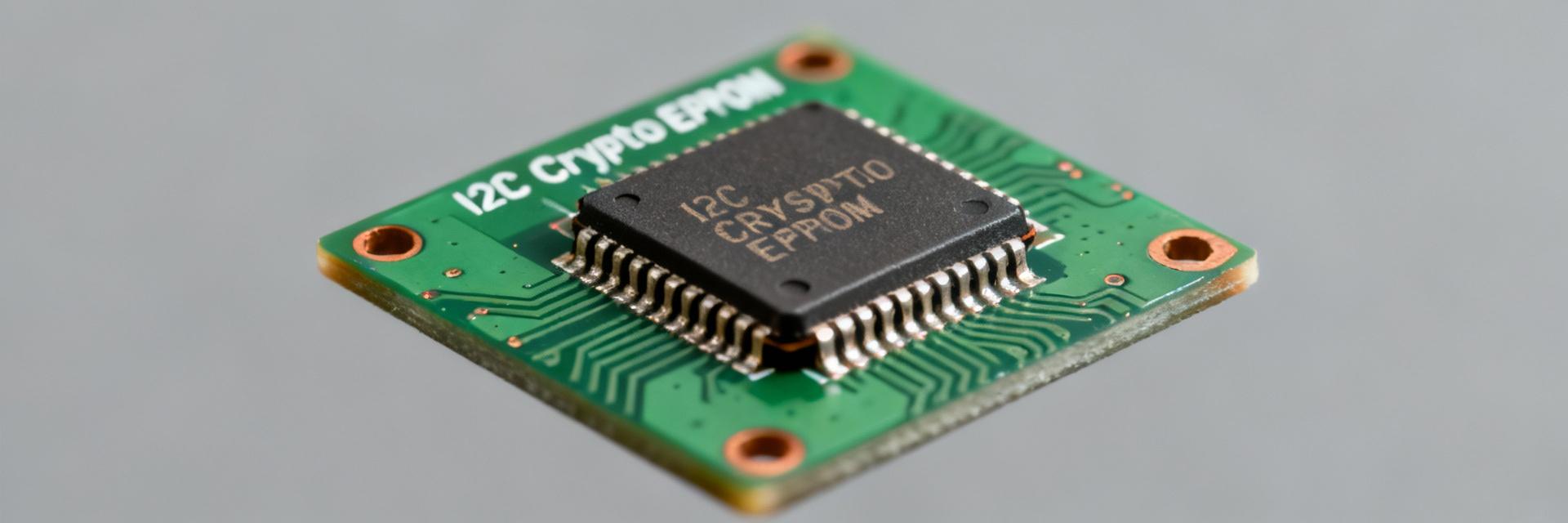
What the device is and where it fits
Point: The device is a low-density CryptoMemory-style secure I2C EEPROM designed to store keys, passwords and configuration data in protected zones. Evidence: The device implements partitioned memory with authentication gates for protected regions. Explanation: This architecture makes it ideal for authentication tokens, IoT device identity, secure configuration storage and access control where secure non-volatile key storage is required without a full TPM.
Key physical and interface highlights
Point: The part is available in small SOIC packages and communicates over a two-wire I2C bus at up to 4 MHz. Evidence: Typical supply range and package options are defined in the official device specification and should be confirmed during design. Explanation: Designers should treat the device like other I2C EEPROMs for wiring, but account for cryptographic timing and power sequencing described in the spec when selecting pull-ups and decoupling.
Core memory architecture & addressing (data analysis)
Memory map and zones
Point: Memory is logically partitioned into configuration, password/authentication zones and user data regions with explicit read/write/authentication permissions. Evidence: The datasheet shows byte- and block-level ranges for configuration versus user areas and special bytes that control locking and lifecycle state. Explanation: Recommended partitioning places immutable keys and provisioning data in protected zones, with rolling nonces or logs in separate writable pages to minimize attack surface and simplify OTA verification.
I2C addressing, page size and write timing
Point: The device uses standard 7-bit I2C addressing with internal page write sizes and self-timed write cycles; write completion must be polled or awaited per timing specs. Evidence: The specification lists internal page boundaries and worst-case write times for page programming and erase-like operations. Explanation: Implement host logic that respects internal page boundaries to avoid data corruption and include retry/backoff on write completion polling for robust firmware.
| SCL frequency | Typical page write | Poll wait |
|---|---|---|
| 100 kHz | 5–10 ms | 5–20 ms |
| 400 kHz | 4–8 ms | 4–15 ms |
| 4 MHz | 3–6 ms | 3–10 ms |
Security features & cryptographic building blocks (data analysis)
Authentication, challenge-response and password zones
Point: The device supports challenge-response authentication using stored secret keys and password-protected zones to gate read/write. Evidence: Authentication sessions use host-issued nonces and device-generated cryptographic responses per the authentication flow described in the spec. Explanation: Typical host flow: request device ID → issue nonce challenge → read device response → verify using host-side key material; this prevents replay and unauthorized reads of protected memory.
Anti-tamper protections, write-lock and lifecycle controls
Point: Hardware-enforced write-locks, permanent lock bits and lifecycle states separate provisioning and operational modes. Evidence: The device exposes lock bits and limited-retry counters for password attempts in the configuration area. Explanation: Use a provisioning window (unlocked) to inject unique secrets, then set permanent locks; understand which protections are irreversible and which are controlled by software to avoid accidental bricking during production.
Integration guide: I2C bus wiring, timing and firmware patterns (method guide)
Hardware integration checklist
Point: Proper physical integration prevents bus errors and protects cryptographic operations. Evidence: Recommended practices include short SDA/SCL runs, correctly sized pull-ups, local decoupling and ESD protection near the device. Explanation: Typical resistor values 4.7kΩ at 3.3V for moderate bus lengths, lower values for higher speeds; always route SDA and SCL as adjacent traces with minimal stubs to avoid ringing at 4 MHz.
Firmware patterns and sample transactions
Point: Implement clear transaction sequences for ID reads, authentication and zone writes. Evidence: Common transaction traces follow START → SLA+W → control byte(s) → data → STOP for writes, and START → SLA+R → data → STOP for reads. Explanation: Example pseudocode below illustrates an auth session and zone lock; include test vectors and expected responses to accelerate bring-up and debug.
// Pseudocode: authenticate
START; SLA+W; CTRL; WRITE(NONCE); STOP;
START; SLA+W; AUTH_CMD; READ(DEVICE_RESPONSE); STOP;
VERIFY(device_response, host_key);
Real-world usage scenarios & examples (case study style)
Example — Secure key storage for an IoT sensor
Point: Use the device to store private keys provisioned at manufacture and enforce unique device identity in field. Evidence: Provisioning flow separates factory programming, lock setting, and field activation steps. Explanation: Typical timeline: manufacturing programming → set permanent locks → ship with unique identity; in-field activation ties the stored key to cloud or local authentication policies without exposing raw key bytes.
Example — Enabling device authentication for firmware updates
Point: Use on-board authentication to verify firmware signatures or to gate update enablers. Evidence: The device verifies a challenge/response and can hold update-enabling flags in locked regions. Explanation: Host computes a firmware image MAC, device verifies update token via challenge-response, and the bootloader enforces policy; measure authentication latency and provisioning throughput to size manufacturing lines.
Deployment checklist, testing and troubleshooting (actionable)
Pre-deployment checklist
Point: Validate memory map, locking states and authentication before mass deployment. Evidence: Include bus stress tests, unique provisioning per unit and audit logs as part of QA. Explanation: Run automated scripts to verify each unit’s lock bits, perform authentication cycles, and confirm environmental margins to catch marginal soldering or timing issues before shipping.
Common issues and debugging tips
Point: Common failures include no ACK on bus, clock stretching, and auth mismatches due to wrong nonces or endian assumptions. Evidence: Hardware-level issues often manifest as missing ACKs; authentication errors usually trace to key or nonce mismatches. Explanation: Use a logic analyzer to capture transactions, validate voltage levels on SDA/SCL, and reproduce failures with minimal host firmware to isolate bus vs. crypto issues.
Summary
The AT88SC0404CA is a compact, purpose-built secure I2C EEPROM that provides cryptographic authentication, multi-zone memory protection and lifecycle controls for constrained systems. Implement correct memory partitioning, robust authentication flows and careful bus/firmware patterns to realize the device’s security benefits while avoiding common integration pitfalls in production environments.
