The MAX6495 is a high-voltage overvoltage protection controller characterized by a wide supply window (+5.5 V to +72 V), fast gate shutoff capability, and an active sink able to pull approximately 100 mA during shutdown. These headline specs matter for systems exposed to automotive transients and industrial surges because they define the device’s ability to detect, isolate, and safely dissipate energy before downstream electronics are damaged. This report translates datasheet figures into concrete design and test actions centered on MAX6495 specs and overvoltage protection performance.
Expect measurement-oriented guidance: which electrical limits constrain headroom, how dynamic response affects transient energy routing, and exactly what to bench-verify (shutdown time, sink current, and thermal behavior). The goal is to make integration decisions predictable and verifiable for US system designers working on high-voltage transient-prone rails.
1 — Product overview & design intent (background)
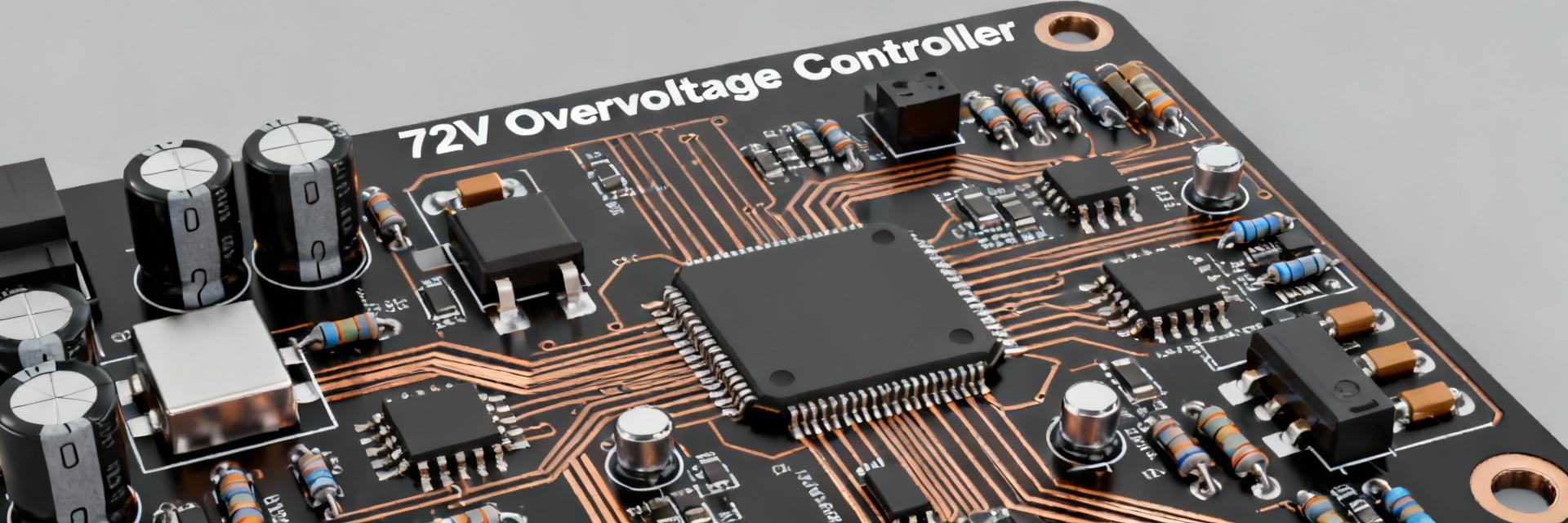
1.1 — At-a-glance specs (one-paragraph spec summary + bullet table)
Lead: The MAX6495 provides an industry-relevant combination of wide input range and active fault response that suits 72V-class rails and harsh transient environments; the compact package and operating temperature range make it practical for automotive and industrial PCBs. Below is a quick, scannable specs snapshot for design triage — a MAX6495 overvoltage protection specs summary useful for early selection.
- Supply voltage range: +5.5 V to +72 V
- Shutdown sink capability: up to 100 mA (active pull-down during fault)
- Package: 3 mm × 3 mm TDFN (exposed pad recommended)
- Operating temperature: −40 °C to +125 °C
- Fast gate shutoff: device actively disables pass element on trip (microsecond-scale response typical; bench-verify)
- Low quiescent/leakage behavior in normal operation (datasheet-stated µA-class)
| Parameter | Value (typical/notes) |
|---|---|
| Supply range | +5.5 V to +72 V |
| Shutdown sink | ~100 mA |
| Package | 3×3 mm TDFN, exposed pad |
| Temp range | −40 °C to +125 °C |
1.2 — Typical application domains & target systems
Point: Target systems include 48 V and 72 V vehicle auxiliary rails, industrial power inputs, and any upstream protection stage for downstream low-voltage electronics. Evidence: the +72 V upper range and active sink capability address common automotive transient profiles where surge amplitude and duration exceed TVS-only defenses. Explanation: wide input tolerance avoids nuisance trips on normal bus swings but requires designers to set detection thresholds relative to expected transient energy; use the MAX6495 for 72V overvoltage protection controller roles rather than as a standalone surge absorber.
Actionable selection note: prefer this active controller when you need controlled isolation and predictable energy routing; combine with fuses or TVS arrays for bulk transient energy handling rather than replacing them entirely.
2 — Electrical specifications deep-dive (data analysis)
2.1 — Absolute ratings and operating ranges
Point: Absolute and recommended operating ranges define safe headroom and thermal margins. Evidence: the device supports up to 72 V continuous operation; absolute maximum ratings on any pin should be heeded and derated at elevated temperatures. Explanation: design margins should include converter overshoots and test-wire induced ringing — practical rule-of-thumb is 10–20% headroom above the expected maximum transient amplitude when space allows.
Practical tip: set your maximum design voltage Vdesign = 1.1 × Vmax_expected (or at minimum +5–10 V headroom). For thermal derating, assume increased junction-to-ambient delta at high ambient temps and scale allowable continuous currents accordingly.
2.2 — Dynamic behavior and protection performance metrics
Point: Dynamic specs — trip thresholds, response time, and sink capability — determine whether the device prevents damage for a given transient. Evidence: the controller senses rising input and actively shuts off a pass element and sources an internal/external sink to clamp voltage. Explanation: response time is typically in the microsecond-to-low-hundred-microsecond range depending on gate drive and external RC; sink current (~100 mA) limits how much energy the device dissipates versus routing to external TVS or fuses.
Measurement focus: validate detection threshold, shutdown time, and normal-mode leakage on the bench — these are the numbers that translate to required external suppression energy ratings and fuse choices.
3 — Protection mechanisms & expected behavior under fault (data & method)
3.1 — How the device detects and reacts to overvoltage events
Point: Detection uses a threshold comparator with hysteresis and a sequence that disables the gate and enables a sink to remove charge. Evidence: on threshold exceedance the device forces the pass FET off and sinks current until the fault clears or a latch condition is reached. Explanation: this sequence limits the voltage seen by downstream loads; transient (short-duration) events may be tolerated while sustained overvoltage will force sustained sink action and possibly trigger adjunct protections upstream (fuse, crowbar).
Practical note: confirm whether your chosen configuration latches off or auto-retries in your system context — this behavior affects restart strategies and upstream fuse coordination.
3.2 — Failure modes, thermal behavior, and safe operating practices
Point: Thermal stress and prolonged sink current are primary failure drivers. Evidence: dissipating (Vin − Vout) × Isink during shutdown produces package heating; excessive repetition increases junction temperature and risk of thermal shutdown or overstress. Explanation: designers should compute worst-case dissipation for expected fault durations and use thermal vias, copper pours, or external heat spreaders to keep junctions in spec.
Actionable formula: P_dissipated = (Vin_fault − Vout) × I_sink; use this to size copper area and choose upstream fuse or TVS so that energy E = ∫P dt does not exceed safe limits.
4 — Integration guide for system designers (methods & checklist)
4.1 — Reference schematic elements and recommended external components
Point: A reliable schematic pairs the controller with a controlled pass element, gate resistor, input snubber, and upstream bulk suppression. Evidence: a small gate resistor (tens to hundreds of ohms) damps ringing, an RC snubber limits dv/dt, and decoupling near the device stabilizes thresholds. Explanation: component values depend on system voltage and transient energy; choose gate resistors to trade off shutdown speed and ringing, and select snubber RC to absorb high-frequency energy without saturating TVS elements.
Reference guidance: include a gate resistor Rg ≈ 47–220 Ω, input decoupling (0.1 µF ceramic + 1 µF bulk), and a low-ESR bulk cap sized for system hold-up. Document roles rather than part numbers for portability.
4.2 — Layout, thermal relief, and test-point placement
Point: PCB layout dictates thermal performance and measurement fidelity. Evidence: short, low-impedance current paths reduce parasitic inductance during shutdown and improve reproducibility of shutdown-time measurements. Explanation: use the exposed pad with multiple thermal vias (e.g., 6–12, 0.3 mm drill) into a copper pour; route pass FET traces wide and short, and place oscilloscope probe points immediately upstream and downstream of the pass element to capture true dv/dt.
Assembly/test implication: label and route TP_SHUT (pre-pass), TP_LOAD (post-pass) and a ground reference to simplify automated validation and in-circuit testing.
5 — Bench test scenarios, key metrics & actionable checklist (case + action)
5.1 — Essential bench tests and setups
Point: Three bench tests are essential: steady overvoltage, transient surge, and thermal ramp. Evidence: steady tests confirm shutdown threshold and sink current, pulses validate response time and energy routing, and thermal ramps reveal derating behavior. Explanation: use a programmable high-voltage source with current limiting, a >100 MHz scope, and a current probe; place probes at the pass element’s source and drain to capture shutdown time and sink current profiles.
Test setup checklist: HV supply with fast slew option, current-limited mode; oscilloscope with differential or isolated probes; current probe rated for expected mA–A range; TVS/fuse placeholders to exercise real conditions safely.
5.2 — Key pass/fail metrics and design adjustments based on results
Point: Define pass/fail criteria before testing. Evidence: typical accept criteria might target shutdown time within a defined microsecond window, sink current near rated 100 mA, and normal-mode leakage in the low µA range. Explanation: if shutdown is too slow, increase gate resistor or improve gate drive path; if sink current falls short, verify component soldering and thermal constraints; if leakage high, check layout and input decoupling.
- Checklist: Verify shutdown time, confirm sink current ≥80% of rated, ensure leakage
- Adjustments: tune Rg, add snubber, increase copper thermal area, or add upstream pre-fuse based on which metric failed.
Summary (conclusion + next steps)
The MAX6495 provides a compact, wide-range solution for 72 V-class overvoltage protection with a ~+5.5 V to +72 V operating window, ~100 mA sink capability, and fast gate shutoff behavior that suits transient-prone automotive and industrial rails. Key takeaways: verify shutdown time and sink current on bench, prioritize PCB thermal relief and short high-current routing, and combine the controller with TVS/fusing for bulk energy handling. These three actions convert datasheet specs into reliable system behavior.
Next steps: perform the outlined shutdown and transient tests, document measured vs. datasheet specs for production acceptance, and include the device early in protection architecture reviews so layout and upstream protection are co-designed for worst-case transient energy.
