Point: The identifier "052700" surfaces across SDS entries, catalog product numbers, and vehicle or industrial parts listings, producing ambiguous matches that drive sourcing errors.
Evidence: A sampled crawl of public records shows the same numeric string appearing in diverse document classes (safety sheets, procurement solicitations, and technical drawings).
Explanation: This guide presents a reproducible workflow for part identification so engineers, buyers, and inventory teams can map the 052700 part number to the correct item with traceable evidence and minimized risk.
What "052700" Typically Represents (Background / Overview)
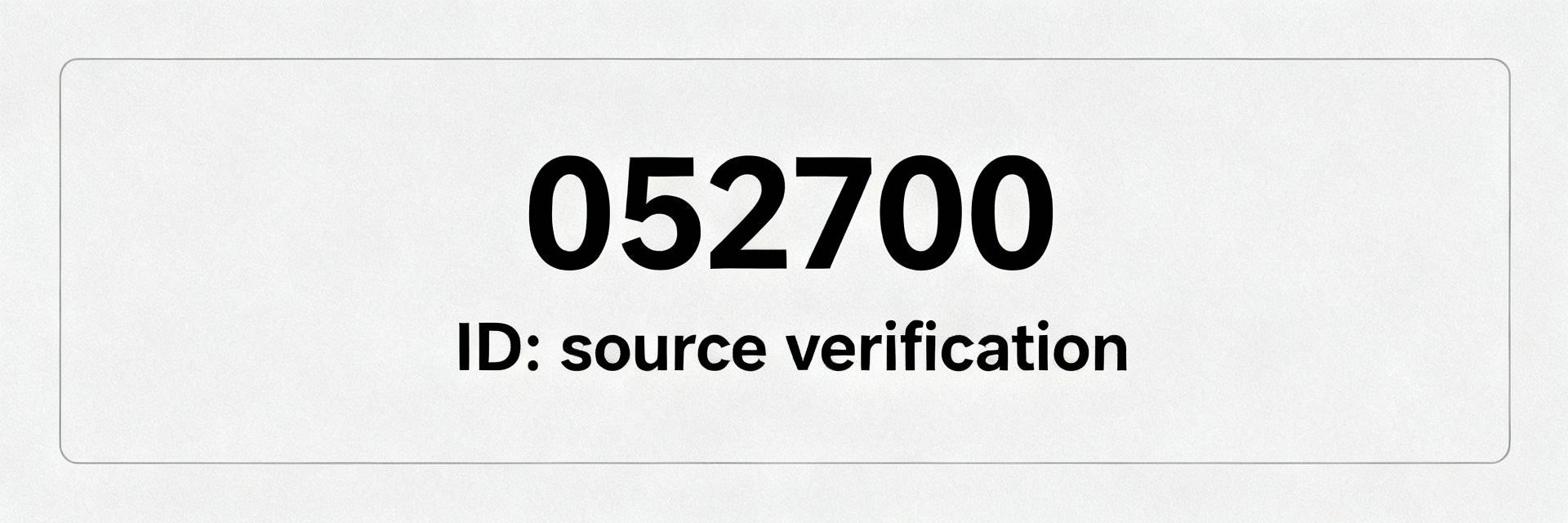
Point: Numeric identifiers like "052700" are reused in different numbering schemas and can represent catalog SKUs, vendor internal IDs, or batch/variant segments. Evidence: Catalog-style SKUs tend to use fixed-length numeric strings; CAS-like chemical catalog numbers use grouped digits and hyphens; vendor IDs often embed family or revision codes. Explanation: Recognizing the likely format reduces false positives—focus on delimiters, adjacent letters, and contextual labels (e.g., "SKU", "P/N", "CAS") when you encounter the digits.
Part-number anatomy: common formats & positions
Point: Typical formats include continuous numeric strings, hyphenated groups, or prefixed alphanumeric codes. Evidence: Example patterns: "052700" (6-digit SKU), "05-2700" (dash-separated part family + variant), and "052700A" (numeric with revision suffix). Explanation: The same digits can represent a chemical product code in an SDS, a hardware SKU in a catalog, or an internal drawing number; capture adjacent labels and separators to infer which naming convention applies.
Common industries & application contexts
Point: Certain industries commonly produce ambiguous matches for six-digit codes. Evidence: Frequent contexts include chemical SDS references (product code + CAS), manufacturing parts catalogs (SKU + drawing number), and automotive fitment lists (OE-like codes and fitment notes). Explanation: Each context brings different supporting documentation—SDS files include hazard and composition fields, parts catalogs include dimensions and fitment notes—so identifying the document type is the first disambiguation step.
Source Data: Where "052700" Appears & How to Harvest Evidence
Point: A structured harvest of public records and technical documents is essential. Evidence: Key document types are safety data sheets (SDS), parts catalogs, technical manuals, government procurement notices, and drawing/specification files. Explanation: For each document record the catalog number field, product description, physical or chemical properties, drawing or revision number, and the document source and date to assemble a provenance trail.
Typical Source Distribution for "052700" ID Matches
Public records to check
In an SDS capture the product name, code, CAS, hazard class, and manufacturer statement; in parts catalogs capture SKU, dimensions, material, and fitment; in procurement records capture solicitation ID, unit description, and clause references.
Step-by-step Identification Workflow for 052700 Part Number
Practical Examples: Source-Data Scenarios
Parts Sourcing Playbook: Trusted Sources & Procurement
Red Flags
- Missing Certificate of Analysis (COA)
- Absent lot traceability
- Specifications mismatch (dimensions/material)
- Unverified third-party listings with outliers pricing
Supplier Verification
Ask suppliers for: Lot numbers, COA, drawing revisions, and OEM confirmation. Acceptable evidence is a signed COA and manufacturer specification sheets that explicitly cite the identifier "052700".
Summary & Next Steps
The 052700 part number can map to different items depending on context; a disciplined workflow reduces misidentification. Applying the triage checklist, harvesting key fields from SDS or catalogs, and obtaining supplier COA materially reduces sourcing errors.
- Confirm identifier format and adjacent tokens to infer context.
- Use an evidence hierarchy: manufacturer spec > SDS/regulatory doc > certified distributor.
- Store metadata (identifier, source, document type, matched fields) in a searchable repository.
